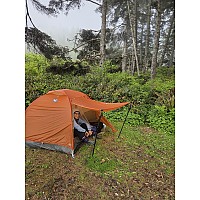
Quest Preying Mantis 4S

The Preying Mantis 4S has been discontinued. If you're looking for something new, check out the best four-season tents for 2026.
 Reviewed by
Dan
September 23, 2006
Tribute to the Quest Preying Mantis Tent
By Dan, written on November 6, 2005 at 12:10 PM EST
Updated on July 9, 2006 at 5:08 PM EST
I’ve been using a Quest Preying Mantis tent for about seven years. It’s a great tent, well-made and with a unique design. As far as I’m concerned, it’s the best tent ever made. Too bad it’s no longer available. (In the photo at the right—taken on the Allagash Wilderness Waterway trip—you can see the Preying Mantis behind my Dad’s Eureka Timberline tent.)
I remember reading Backpacker magazine in the early ‘90’s and seeing small ads for the Preying Mantis. The ads did their job: they left me wanting to know more about the tent, and wanting to have one. But, as I remember it, this was a nearly-$400 tent and I never had near that much money. I finally bought a Eureka Cirrus tent a few years later and forgot about the Preying Mantis.
Then, one day during the dot-com era of exceptional deals I came across a site that had the newly-discontinued Quest Preying Mantis for about $125. I snatched it up quick!
The Preying Mantis was a unique design. Most obviously, it offered a gigantic vestibule, roughly 2/3rds the size of the tent itself. That means this two-man tent really does comfortably fit two people because all of the gear easily sits in the vestibule. Overall, the tent is about 12-1/2 feet long.
The size of the vestibule isn’t the only thing that makes it unique, though. The zipper to enter/exit the vestibule (and the tent, of course) is on the side of the fly—not on the ground. When entering, this isn’t such a big deal but it’s important when exiting. If you’ve got a vestibule with the zipper on the ground, you know that you basically need to plant your face in the ground to reach it. And unless you can bend in half, you don’t want to put your boots on before opening the vestibule because you’ll track dirt and mud into the tent; but if you don’t put your boots on first and it’s raining, you’ve got rain pouring into your tent while trying to get the boots on. The Preying Mantis completely avoids this trouble by just putting the door and zipper in the middle of the vestibule wall! I can sit in the tent, put my boots on in the vestibule, then open the vestibule door to exit—never getting wet or planting my face in the mud to reach the zipper!
Another great design feature is that the tent is entirely freestanding. Most “freestanding” tents still require you to stake the fly out to be effective in a rainstorm, but the Preying Mantis’ fly doesn’t. (There are many areas to stake out, and they certainly help stretch the fly a little more, but it’s entirely effective unstaked.) Obviously, the whole fly wraps tightly around the tent, unlike many others that cover just the sides and leave the front and back open or just a demi-fly covering the vents. The result is that the tent is always completely dry. I’ve been camping in some pretty horrendous weather with this tent, and there’s never been a drop of rain inside it.
Similarly, the shape of the tent is great at diverting wind. The tent is very quiet (even in heavy wind) because there’s no loose fabric or open edges for the wind to catch. The Preying Mantis has four guy lines to help anchor the tent in inclimate weather, but the tent barely moves as-is, so I’ve never attached them to the fly.
The tent is mostly screen. That’s a pretty common feature of 3-season tents now, but back then that was a rather brilliant innovation. Airflow is significantly better than in any other tent I’ve ever been in. Of course, in the winter it’s amazing just how little warmth the tent provides. In my experience, most solid-wall tents are at least 10 degrees Farenheit warmer!
The tent itself is longer than most—about seven feet. I often sleep with my arms over my head, and there’s plenty of room to do that in this tent. The tent’s about 40 inches wide and tall, making it comfortable but not large enough to kneel in. As I mentioned before, with the fly over the tent, it’s about 12 feet. The whole tent—including stakes and the guy lines I’ve never used—weighs just 6 pounds, 2 ounces.
I’ve used this tent quite a bit. I’d estimate it has seen about 150 nights of use. The Preying Mantis has held up very well (though I do take very good care of it). Last winter, however, the main pole hub connector snapped at the edge. There’s enough of a lip left that the tent goes together fine, but I doubt it would last another winter. And this past summer, the vestibule zipper began falling apart: it’s missing a few teeth and jams constantly.
As I said in the beginning, the Quest Preying Mantis is out of production. In fact, Quest doesn’t even produce the same kind of high-quality equipment anymore. So, I needed a replacement tent. A few weeks ago I bought an EMS Moonshine, which seems like a good tent with several great features to it. Of course, I immediately noticed that I had to shove my face in the dirt to get the vestibule open!
Design: three-season freestanding dome")
Sleeps: 2
Ease of Setup: easy
Weight: 10
Price Paid: $344
Reviewed by
Brent Henry
September 8, 1998
Four years ago I bought a 3 season Preying Mantis and it has been absolutely superb. However, when I saw the 4S on sale for $261 (cdn), I couldn't help myself, I bought one, then I told a couple friends and they bought some and so on and so on. So now I'm telling everyone else!
Anyways, about the tent itself. It is very similar to my 3-season version, except the 4S is a little bigger (and tougher) in every direction. It is about 6" longer (for all of you tall folk -- check out 96"), it is about 4" wider and the best part about its additional width is that the walls are much more upright (due to the double-crossing support poles). In the 3S you can only sit up if you're near the middle of the floor space, however in the 4S you have much more head and elbow room.
Now speaking about additional space, if you thought the vestibule was big on the 3S, well this one is gymungous (quoting my 6-year-old son), another 4" in length and 4" in width making it big enough to fit a small herd of moose. One very nice touch with the vestibule is that they have now made it with 2 opposing doors. This way, you can enter or exit on the side away from the wind (and blowing rain or snow) and keep everything dry inside.
To batten down the hatches for those cold nights, you can zip shut the mesh door with a nylon inner flap as you can with the 2 large triangular mesh windows in the side walls.
As with the 3S, for flow through ventillation, you can still roll the fly back (leaving the vestibule in-tact) and if you unzip the door flap and the 2 side windows, you'll be living very comfortable on those hot summer nights (do I hear a song in there somewhere?). However, the down side is if it is raining on a hot humid night, you'll have to battened down the fly, it can get hot! My solution was to set up an awning over top of the tent and fend off the rain that way, thus you can keep the fly rolled back. Remember, this is an expedition tent, yet with good ventilation!
The tent is remarkably taut, even without any stakes you can bounce dimes off the fly! If you have the will to use all 28 stakes that are provided (20 for the tent/fly loops and 8 for guy line connections) you will have a structure so solid that it could hold up 4 feet of snow without a problem (not speaking from experience though).
Yes, 28 stakes and 8 guy lines (included), well that accounts for a couple of pounds. If you cut that back to only 8 stakes and no guy lines, the weight would drop from 9.1 lbs. to about 7.5 lbs., not bad for a bombproof shelter!
One of the coolest enhancements on this tent (over my old 3S) is the use of what Quest calls "Super Fly" connectors. They are super hardened plastic fittings that the poles attach into (elliminating metal gromets) and they have a lip in the ends to hook the fly into (ie. no moving parts to break). Apparently, this makes it very easy to connect and disconnect the fly with mitts on... no fumbling with small (cold weather breakable) clip buckles.
Well, I am very impressed with this tent and I have had it for just over a month. On my very first night out, we had a heavy downpour, that lasted all night long (as best I could tell) and not a drop got in!
I will provide an update after my first winter experience in the 4S. See you in about 6 months.
Design: Elongated Expedition Dome
Sleeps: 2
Ease of Setup: Very fast and easy - first time in less then 5 minutes
Weight: 9.1 lbs.
Price Paid: $680 (cdn)
Reviewed by
Scott Geiger
April 17, 2008
I bought this tent new from an outfitter in Ely, MN, back in 1995. I spent many snowy and -40 nights in this tent while trekking the BWCAW over the course of 5 years. This tent has seen punishment, being tossed into a canoe at sub-zero temps, camping on ice of a frozen lake, and being set up in the black of night with winds howling!
At first I felt foolish for spending so much on a tent until I spent my first winter night in it. It is an unbelievably awesome design. NO frost on the inside in the morning is not only nice, it is necessary for winter survival, when you spend 2 months in it miles from the nearest cabin! Some may balk at the weight of this tent but once you spend a restful winter night in it, it will seem like a feather in the morning.
I found the footprint of this tent to be invaluable on the many cramped sites in the BWCAW, while fellow campers had trouble pitching their tent comfortably on the same spot.
The vestibule was an incredible asset, allowing me shelter to ice fish from it in survival mode. Although it sleeps 2, it was perfect for one with all the extra gear of winter camping on extended trips.
A very durable tent for serious winter camping! Still in use after 13 years should say something about its quality of workmanship. I hope this tent never goes out of production.
Design: four-season
Sleeps: 2
Ease of Setup: this tent sets up fairly easy except it shrinks in extreme cold making it hard to set the pole ends into the "pockets"
Weight: 9.5 lbs
Price Paid: $369
Reviewed by
Ron
+14
August 12, 2014
I use this tent in all four seasons year round, never a drop of water on me, Extremely sturdy in high winds. I have never had it come apart in a storm. This confidence makes it easy to get a nice peaceful night's sleep knowing your gear won't let you down.
Pros
- Very sturdy strong equipment.
- Quality built, takes a beating (wind) and never budges.
- Great space, both tent floor space and the vestibule
Cons
- The only con I can think of is that it doesn't put itself together!
- Maybe just a little heavy for a backpack!
This is by far one of the best four-season tents I have ever owned. I have backpacked all over the U.S... It is well worth the weight to know that your tent is going to stay put in any weather.
The vestibule has a lot of room for gear storage and the tent floor space easily sleeps one and comfortably sleeps two (smaller adults). On top of all the tent provides out in the back country, it is also awesome looking!!
Two thumbs up on my tent-o-meter!!
Source: bought it new
Price Paid: $479
Reviewed by
Stever Dude
 November 11, 2007
I used this tent a lot in college. I've had it for probably 13 yrs although since I moved to Texas (9 yrs) it hasn't seen much use. I've never been totally in love with it, primarily because it's a bit of a chore to set up and you have to bring the fly along whether you want to or not.
That said, once it's set up the thing is killer. The vestibule rules the wasteland so to speak, and you're in there solid no matter what weather comes along. I had to take the fly back after my first trip because the underside totally burned in the sun. That was odd. Not the lightest tent on earth and I think some of the early poles might have bent as well.
Design: 4-season elongate dome
Sleeps: 2
Ease of Setup: medium
Weight: 8 lbs
Price Paid: ~$400?
Reviewed by
John E. Juhl
April 28, 2004
I've been trekking and mountaineering for 35 years and the best tent i've had is the Quest Mantis. i've had the Mantis 4S, early version, for 11 years. It has functioned very well on every trek from an ascent on Denali where we had two days of blizzard conditions resulting in complete burial under four and a half feet of snow (the vestibule saved a lot of exposure serving several purposes) to Aconcagua where it withstood winds of approximately 100+ mph. Even in humid and stormy mid-western conditions, and below zero ski and snowshoe trekking, the ventilation is excellent. The fly, with its roll-up feature makes for great star gazing, weather permitting, and allows easy weatherproof access through the opposing vestibule doors. A great two man expedition quality tent that breaks down easily to share its eight pounds + weight with your treking partner. The Mantis also stores easily for bicycle touring by removing the frame hubs from the tent body and storing them separately, allowing greater compressibility of the tent body and fly.
Design: four season free standing with 28 guy points
Sleeps: 2
Ease of Setup: one person in 4 minutes-with frame hubs attached to tent body
Weight: 8.5 lbs.
Price Paid: $400
Reviewed by
Ron Stephenson
+3
 February 14, 2022
It is easy to assemble. It is a good size and weight for kayaking or biking.
Pros
- I like the big vestibule.
- I like the weight for kayaking and bike trips.
Cons
- When it rained everything in the vestibule got wet. How do I get in it without soaking everything I am storing in the vestibule?
- Also it lets water in at the back end opposite to the vestibule. What can I put on to prevent the leak?
I can not keep the rain out when I open the vestibule. I like the size of the vestibule.
Background
I have used it for kayaking trips, about 20 days.
Source: bought it used
Price Paid: I do not remember
Reviewed by
Bryce
August 31, 2000
I bought this tent used at a great price. I haven't been more impressed than I am with this one. The vestibule is HUGE! I fit 2 packs, boots, and a dog under it. The interior space is great also. I am 6'2" and my wife is 5'10" and we fit great! I even have plenty of headroom when sitting up near the door. For a 4-season the ventilation is great also. I would recomend this tent to anyone!
Design: 4 season
Sleeps: 2
Ease of Setup: Easy to set up once you try it a few times at home.
Weight: 8 lbs
Price Paid: $225 (used)
Reviewed by
Kathylc
May 29, 2006
Bought this in 1995 for backcountry trips in Alaska and am still loving it. Its two side screen panels can be zipped for maximum heat conservation. The vestibule fits both backpacks. We've even cooked under the vestibule a few times. My favorite feature: the rear portion of the rainfly can be rolled up (for venting) and the vestibule still stands! We can never go to another, and with good care hopefully will never have to.
Design: 4S
Sleeps: 2
Ease of Setup: very fast and easy
Reviewed by
anonymous
December 15, 2004
We've had this tent for 10 years. It was bought as a store demo. We've been in some terrible winds and rain in eastern Nova Scotia, when other tents were sailing accross the ground. We've also been caught in rain storms in northern Quebec. It's the best tent I've ever had. I am so impressed with their product I bought a lightweight Stingray for biking.
It's too bad they have gone out of business.
Price Paid: $300
Your Review
You May Like
Specs
| Price |
Reviewers Paid: $225.00-$479.00 |