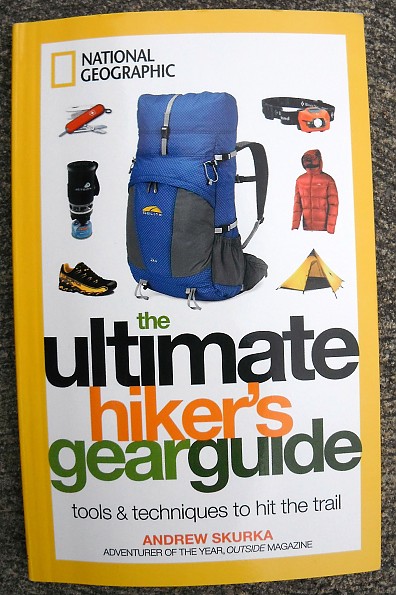
National Geographic The Ultimate Hiker’s Gear Guide



 Reviewed by
Rick-Pittsburgh
+1,816
 April 25, 2013 (original Apr 11, 2012)
Regardless of whether you are a trail novice or a seasoned trail veteran there is something for everyone in this gear guide that can be adopted into one's practices while on your backcountry journeys. I highly recommend that anyone that has a love for being in the backcountry to take a few moments and seriously consider reading this book.
Pros
- Very well written, thought out, and presented.
- Not only is "The Ultimate Hiker's Gear Guide" a great learning tool that one can benefit from, but it is also quite enjoyable to read as well.
- There is something for everyone in regards to the content.
- One of the best gear guides I have read to date.
Cons
- I found myself wishing the author would have gotten a little more in depth in regards to traction control devices and snowshoes other than just mentioning them.
I recently had the opportunity to read National Geographic's The Ultimate Hiker’s Gear Guide by Andrew Skurka and I have to say I am quite impressed... So impressed that I actually read it twice and I am going for a "3 peat."
When I started reading this guide I was presented with a question: "Am I an Ultimate Hiker or an Ultimate Camper?"
I never really looked at my approach to my backcountry endeavors this way. I always considered myself a pack mule(that is putting it mildly)although I do own some UL gear. After fully reading this book I have to say that I find myself reevaluating some of my approaches to my own backcountry forays. The content contained within the pages made me think quite a bit, and that is putting it mildly.
There is a substantial wealth of knowledge contained within this book. I have no problem recommending it to anyone and everyone out there regardless of your own personal backcountry experience level. Whether you are interested in trekking poles, shelters, waterproof/breathable fabrics or Clo values it is covered in this informative, well written, very well thought out book.
Content:
The book itself is divided into three sections (with the exception of the introduction, glossary, credits, acknowledgments, and index) as follows:
Section 1: Why, When, & Where (pages 8-27)
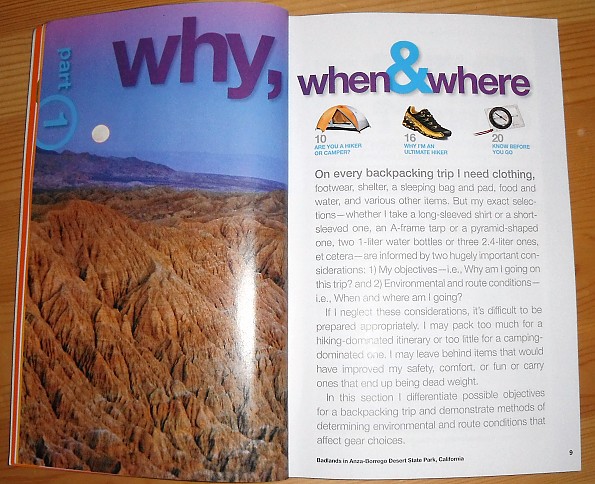
In this section the author discusses subjects such as trip objectives, as well as the different aspects of the trip that one should take into consideration, such as environmental and route conditions which have a great deal of influence in regards to what gear is needed and what is better off left at home for the trip at hand.
This is also the section where you may initially ask yourself if you are an "Ultimate Hiker" or an "Ultimate Camper."
Ultimate Hikers
Andrew Skurka describes Ultimate Hikers as those that like "to put one foot in front of the other — they simply love to walk." They are very knowledgeable in regards to their trip objectives, route and environmental conditions, and covering ground.
Ultimate Hikers scrutinize each item that they carry in regards to weight and maximize each item to its full potential when it comes to use. Their knowledge and skill level is very high so they can safely cover massive chunks of landscape while carrying minimal gear and supplies.
Ultimate Campers
Ultimate Campers take a different approach. They are more concerned with non-hiking activities, such as birding, fishing, and photography. While they may possess knowledge in regards to the area that they are traveling through, they take more than they need to ensure that if things go south they will come out unscathed.
Pack weight isn't a main concern, although they aren't packing everything including the kitchen sink. The gear and supplies Ultimate Campers carry are typically easy to use, but somewhat heavy. Their trip itinerary is more relaxed. Ultimate Campers are geared more towards setting camp in one location and not necessarily covering massive chunks of terrain.
To sum it up, Ultimate Campers are more concerned with R&R than anything else.
Section 2: Tools & Techniques (pages 28-191)
This is the meat and potatoes of the book.
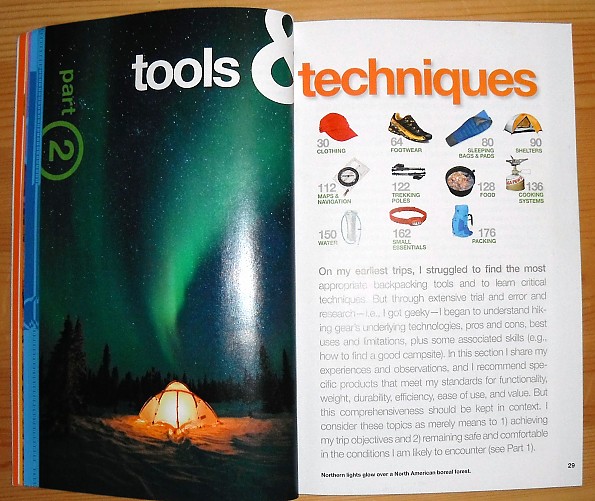
Section 2 covers everything from small essentials and shelters to waterproof breathable shells and Clo values (used to measure the warmth of synthetic filled products). This section also covers subjects such as making an alcohol stove from a cat food can to how Andrew Skurka preps his own food (pre-trip and in field.)
Any gear recommendations in this section are based on the author's personal standards and experiences as follows: functionality, weight, durability, efficiency, ease of use, and overall value.
I found this section to be very informative and I learned quite a bit from its content. I also found that while I already knew a lot of what was contained in this section I had a tendency to overlook a lot of what I knew when preparing for my own trips. This was a good eye opener for me.
(On a side note...I am now the proud owner of quite a few Fancy Feast alcohol stoves thanks to this section. I can't seem to help myself. They are just so much fun to make and the cats don't mind one bit, although I may have to change Jynx's name to The Blob.)
On the negative side, I found this section lacking in regards to two items that I know many use traction; devices and snowshoes. Other than being mentioned in the Ground Cover section in Part 1 and included in a winter gear list in Part 3 (page 207) they are really not discussed to any real extent.
My opinion is that in order for a book to be titled The Ultimate Hiker's Gear Guide this subject should have been covered more in depth. These items are not even listed in the index.
Section 3: Sample Gear Kits (pages 192-215)
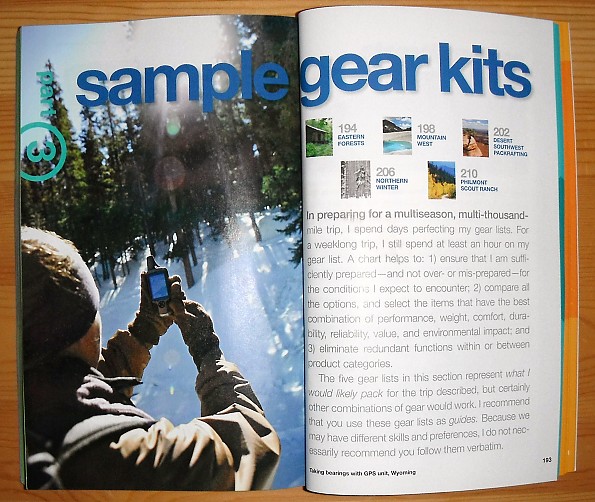
This section covers what the author would likely pack for five different types of trips in regards to season and location. The areas included are as:
- Eastern Forests
- Mountain West
- Desert SW Packrafting
- Northern Winter
- Philmont Scout Ranch
The author also recognizes the fact that one should utilize these lists as guides, because not everyone has the same skill set or preferences as he does. He does not recommend that one follow them verbatim for the reasons stated above.
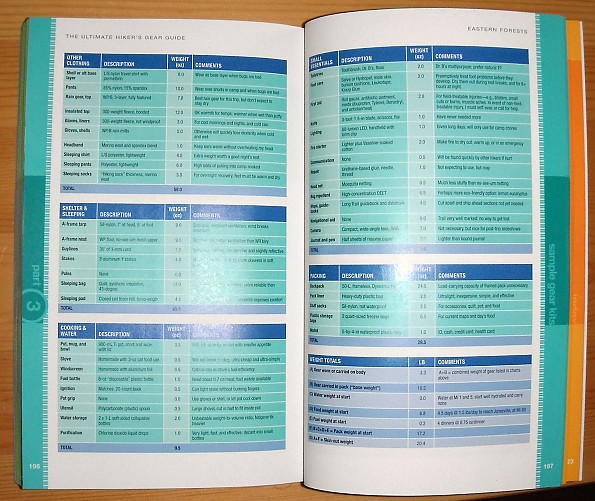
This section is broken up into charts that each are broken up into four sections consisting of the item itself, a description, weight (oz), and comments, as seen below:
Other included information:
- Versus charts
Summarizes the similarities and differences between materials, such as synthetic insulation compared to down insulation, as well as other items such as double wall tents in comparison to single walls, tarp shelters, and hammocks.
- How2
Covers step-by-step directions in detail, such as how a framed pack transfers weight as opposed to a frameless pack.
- Tips
Advice that is relevant to the text but is not necessarily covered in the text itself such as Landsat imagery.
- Tried & True
Covers subjects such as how to find a good campsite, how to packraft, and how to pack a backpack.
- Skurka's Picks
Recommendations that are based on the author's own personal preferences and experiences.
From a reader's perspective:
I have to say that I found the overall layout of The Ultimate Hiker’s Gear Guide very easy on the eyes. There just seems to be a really smooth flow to its content.
For instance, the author waits to cover packs until pretty much the end of the Tools & Techniques section of the book. This approach makes total sense to me. It reflects the proper approach that one should take in regards to purchasing a pack to meet their own individual needs.
Would you rather purchase your pack up front before you actually purchase your gear and hope your gear fits? Or would you rather purchase your gear and then purchase your pack so you can get the best dialed-in fit for your gear in regards to interior volume and capacity?
In closing:
The information contained within The Ultimate Hiker’s Gear Guide is priceless in my own opinion. It could take an individual many hours to acquire the equivalent knowledge through research online.
If one were to actually learn the information contained within the book from personal experience it could take many years of trial and error, not to mention the amount of money lost from the purchase of gear that is not up to your individual needs, although you thought the items would during your initial purchases.
I personally cannot recommend this book enough even though it did get hit for a half star for the lack of reference to traction control devices and snowshoes. For the most part, other than that, it pretty much covers all of the bases. There was not one time that I can recall that I actually became bored or uninterested with its content.
Regardless, if you are a trail novice, a seasoned trail veteran, a day hiker, or a thru-hiker that likes to rack up endless miles of trail time this book should definitely be one that you consider adding to your "must read" list.
It is that good.
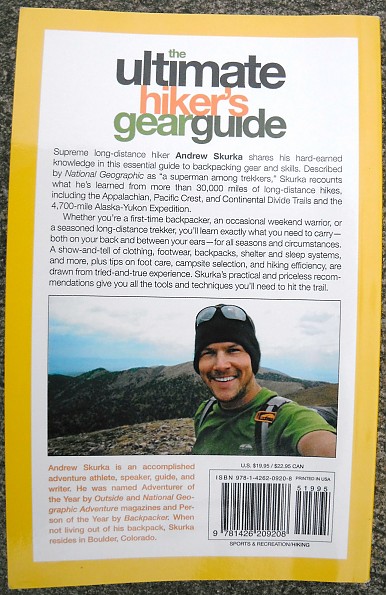
As always, I want to thank you for taking the time to read my review of "The Ultimate Hiker’s Gear Guide" by Andrew Skurka. I really enjoyed this book, as you can see by my feedback in the review.
I also learned a few things as well. One of the biggest things that I learned is I am not an Ultimate Hiker nor am I an Ultimate Camper.
I am an Ultimate Hiking, ultra-light, uber-heavy, Ultimate Camping, pack mule... :p
Happy hiking-Rick
Publisher: National Geographic
Release Date: Feb. 21, 2012
Pages: 224
Source: received for testing via the Trailspace Review Corps
 Reviewed by
kelly83686
+45
June 7, 2012
One of the better books on outdoor gear supported by personal insights based on experience.
Pros
- Advice based on personal experience and gear actually used, not on getting paid to market and sell gear
I've reached the point where I'm fairly gear-literate. I know about tarps vs tents, quilts vs sleeping bags, leaving unnecessary gear behind to save weight, etc etc etc. But what I found refreshing about Mr. Skurka's book (Andrew--does he ever go by Andy?) is APPLICATION.
That's where I am in my outdoor development, I want to know from those who have logged a few thousand (or few ten-thousands) of miles is what they have found that works based on experience. And that's why I rate this book as one of my two favorites (the other is Ray Jardine's Trail Life book).
Where this book stands out from others are the personal insights. Andrew can "talk the talk" because he literally has "walked the walk." I particularly liked his relating of his early experience tackling the Appalachain Trail. He's had to learn the hard way in some cases. (Makes him seem more like the rest of us mere mortals!) :^)
Oh yes, there is a lot of information on gear as well that both beginners and experienced hikers and backpackers will find insightful and useful.
Definite recommend.
PS-I bought my copy off Amazon, but if you order from Andrew's Web site I understand he'll autograph it for you.
Source: bought it new
Price Paid: $12
 Reviewed by
GeoGeko
RETAILER
+3
May 4, 2012
Great read! Flows nicely with great stories intermingled in the writing. I will definitely be checking back with this book to keep my pack light and get me closer to ultimate hiker status.
Pros
- Easy read
- Great information
I always thought I was a hiker at heart but this book changed my mind. With the amount of comfort items that I haul with me everywhere I would sit firmly in the camper realm.
With a desire to increase my distances while camping I have started using the tips in this book to lighten my load and make my adventures more efficient.
The book is a great read with stories and tips throughout that will help even the most experienced hiker. The author has a different skill set than most authors in that he has done the extreme when it comes to hiking and can attest to each of his tips through experience and failure.
Definitely recommended by me.
Source: received it as a sample, freebie, or prize (won in Trailspace's "Ultimate Hiker's" book giveaway)
Your Review
Where to Buy



You May Like
Specs
| Price |
MSRP: $19.95 Historic Range: $9.93-$19.95 Reviewers Paid: $12.00 |