
Allpowers 100W Foldable Solar Panel SP012



 Reviewed by
Vladimir Gorbunov
TOP 10 REVIEWER
+3,273
May 27, 2026 (original May 25, 2026)
A very powerful, travel-friendly solar charger—portable and ready to use right from the box. On the other hand, it is difficult to align with the sun and it represents just the core of a complex solar power station. Due to the latter’s weight and complexity, its application scope is limited to long unsupported trips with high energy consumption.
Pros
- Super compact folded, considering its 0.9 square meter area when unfolded
- Delivers usable power even in suboptimal conditions (thanks to Sunpower or equivalent cells)
- Provides Type-C PD, dual USB and 18V DC output right from the box
- Ability to stack several solar panels
- Heavy-duty protection against physical damage to the cells
Cons
- DC connector box is not waterproof—the unmodded solar panel cannot be left on its own for days
- Heavyweight—for many usage scenarios a rechargeable battery would be lighter, simpler, and more reliable
- Lacks a rigidity—requires a supporting frame for optimum positioning on the sun to maximize the power output
- Requires complicated and heavy external circuitry to utilize its full power reliably and without losses
Background
In recent years my outdoor activities shifted towards amateur radio DX-peditions. As a licensed ham operator (my callsign is R1BNG), I make wilderness trips with my power-hungry radio equipment, which consume up to 140 Watts during the transmission, to various remote and rare locations, where I make radio contacts with fellow hams from many countries.
Last year I performed a 10-day cycling trip, where I was spending about 100 watt-hours (Wh) of electricity every single day to power my radio activities (for comparison, a typical 20,000 mAh power bank is 74 Wh). My daily amount of energy consumption was so large that it would be enough to supply a couple of hikers over a week. Luckily I planned that trip in such a way that every day or two I was able to charge my batteries while dining at cafes and at fuel stations. But of course the idea of binding myself to power outlets throughout my entire trip wasn’t really inspiring to me… Let’s say, on a kayaking trip there are usually no power outlets, cafes or gas stations at all!
And the only way to get 100-150 Wh of energy per day from nothing was using solar power. For instance, a bicycle dynamo provides just 3-6 watts at high speed, therefore after a 5-hour ride I’ll get just 15-30 Wh—or even less if riding slowly. That’s enough for a smartphone and a camera, but for radio equipment I need 5 times more energy. That's where solar chargers come in.
About solar charging technology
About 8 years ago I posted my review of a 14W solar charger (although in real life it only provided closer to 7 watts), consisting of four standard Sunpower cells (cut into 6 slices each). Such cells, easily distinguishable by their plain appearance, square shape and (usually) slightly cut corners, are considered a gold standard for solar generation. Each cell can theoretically provide up to 3.5 watts—as per the manufacturer’s datasheet.
For now I decided to try a much more powerful solar charger—Allpowers SP012—consisting of as many as 30 such cells! In theory, it could provide up to 100 watts of solar power, fulfilling my daily energy needs in just a couple of hours… in ideal conditions.
Such powerful solar chargers are serious beasts, and they require complicated and heavy external circuitry to ensure a stable power supply in real‑world conditions. Without diving into technical details, if you draw too much power from a solar cell, the generation collapses, and you get almost nothing. If you draw too little, you simply waste precious photons by getting less power than you could.
Moreover, the power output of a raw solar panel is constantly changing—due to passing clouds, accidental shading, temperature variations, sun movement, etc. Most USB‑powered devices (especially the complicated ones, such as smartphones and advanced power banks) tend to disregard such an erratic power source: they either fall back to the least sophisticated charging mode (5V), or simply report an error and stop charging until you replug them.
Therefore an external circuitry (the solar controller, which regulates the load on the solar panel to draw the maximum possible power at all times) is essential to ensure minimal energy losses, reliable and stable charging. And additionally in most cases it should include the buffer battery to keep the charging running under variable sun conditions.
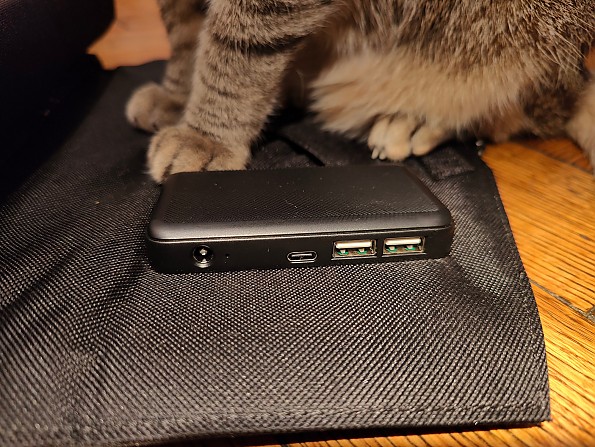
In Allpowers SP012 there are embedded USB outlets for charging your equipment directly, but those aren’t regulated by a solar controller, and in less than ideal conditions (improper alignment to the sun, clouds, shading etc.) the power output may drop dramatically—down to zero—and depending on the device connected to the USB port, it may not recover back. Therefore an external solar MPPT (maximum power point tracking) controller is needed.
Also, USB ports are grossly underpowered by design, and their use for charging your devices from a 100W solar panel would waste most of available solar energy, necessitating the use of a buffer battery to collect all the energy during sunny hours and release it when needed.
The buffer battery is another major source of weight and complexity, as you need plenty of reserve energy for overcast and rainy days, as well as enough room for collecting the solar energy on sunny days. To address all these problems, large solar panels are usually coupled with so-called “solar power stations” (solar controller + large buffer battery with DC and USB outputs + AC converter in one box), which are usually expensive and difficult to transport without a car.
Allpowers SP012 — the core of custom solar power station
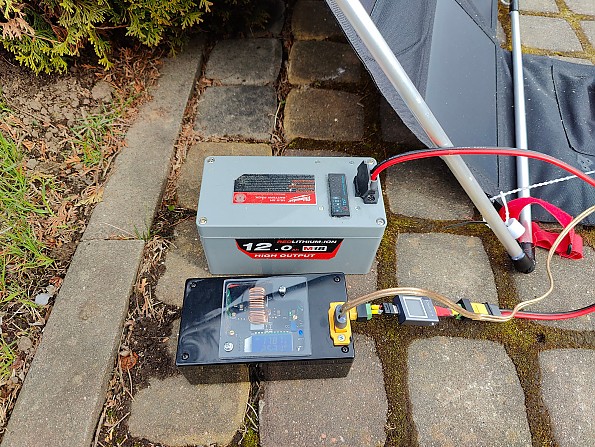
As a reasonably lightweight solution, I built my own solar controller (ZK-SJ20 buck-boost controller with analog MPPT adjustment), coupled it with my existing self-made 250 Wh 5S Li-Ion battery, and thus the relatively compact and lightweight solution was made. Unfortunately the electromagnetic interference (EMI) caused by the controller makes it impossible to charge the battery while operating the radio.
As a backup option I am able to connect my battery to the solar panel directly, bypassing the controller and getting rid of EMI. In most cases it would have been much less effective, but luckily in my specific case the nominal voltages of both devices (18V) match quite closely, and therefore it’s workable for me (having the protected battery against overcharging, of course).
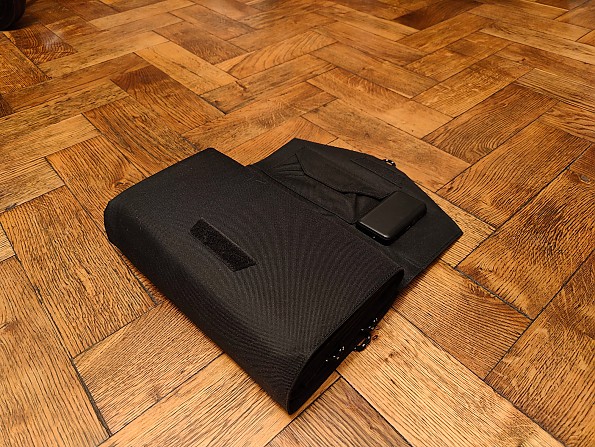
Speaking of the solar panel itself, it’s made of 30 cells in 15 pairs (3S5P), which are folded into the neat case with dimensions of 30×18×9 cm (11.8×7.1×3.5 in), and weight of 2700 g (6.0 lb). Most of this weight comes from the heavy-duty protection against physical damage, as bare solar cells are very fragile.
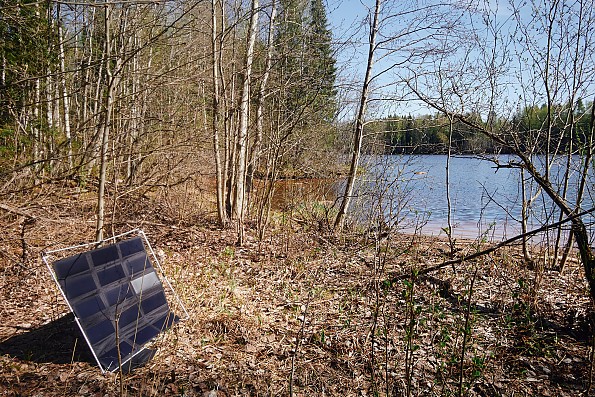
Unfolded dimensions of the solar panel are 93×93 cm (36.6×36.6 in), plus an additional fabric leaf containing the DC connector box. This box contains the Type-C socket (PD-compatible), dual USB 5V sockets, 18V 2.5×5.5 DC outlet (coming directly from the solar cells) and a 2.1x5.5 DC inlet for stacking several solar panels in an array. The 1-meter cable for that, or for connecting some device to the 18V outlet, is provided, along with multiple DC adapters (mostly for laptop charging) and several carabiners for hanging the solar panel.
(Frankly, I don’t see much sense in stacking several solar panels of this particular kind, except for stationary base camps, where rigid non-folding panels would be more in place.)
The connector box is not sealed (just coated with lacquer on the inside), and water may freely enter it if leaving the solar panel unattended under rain (or during a boating trip), leading to corrosion and potential malfunction. Therefore I decided to remove that box by prying open the fabric sleeve carefully, unscrewing 4 screws from the inside, and replacing the box with a simple cable with an ideal diode chip (preventing the situation where a connected battery discharges through the solar cell).
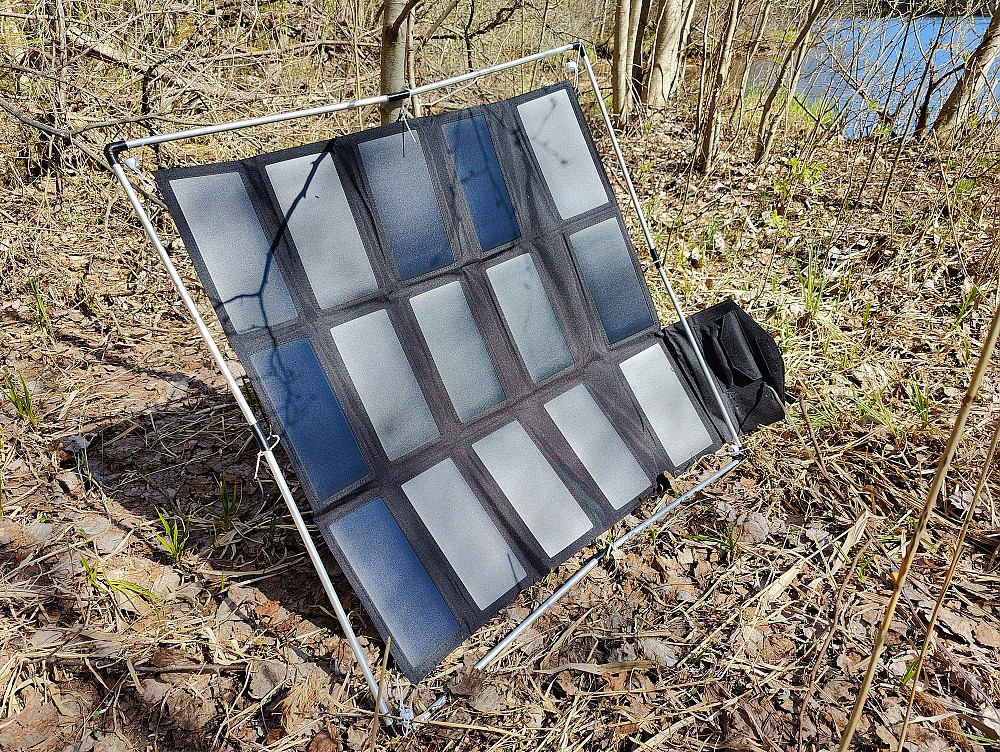
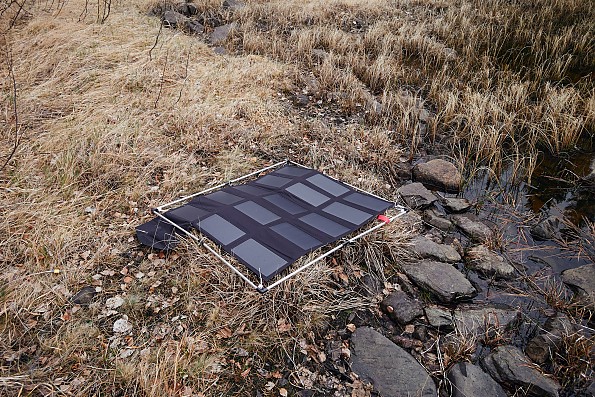
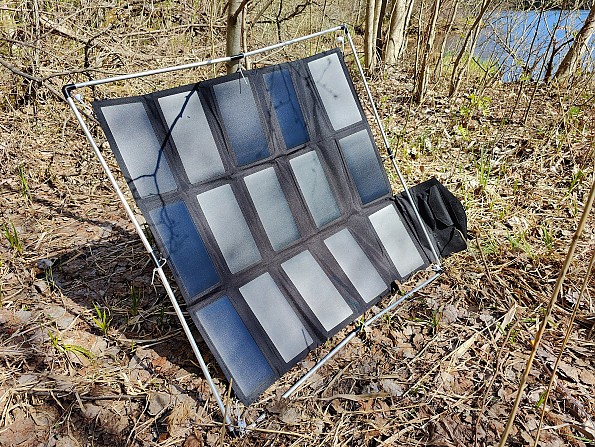
The unfolded solar panel is not rigid in any way. Therefore it cannot be tilted towards the sun at an optimum angle to the ground (which roughly equals the value of your latitude—60°N for my home region). The panel can only be laid flat on the ground, or, alternatively, hung vertically from a clothesline—in both cases the losses would be quite substantial, unless it’s cloudy (or you travel in tropics), when horizontal placement is just fine. Additionally, if laid on some object (like a kayak), the panel would wrap around it, shading some parts from the sun entirely, and effectively blocking the power output altogether.
To solve this issue, I built a lightweight foldable semi-rigid frame, using the 12-mm aluminum tubes, water pipe connectors and tent shock cord. The solar panel is attached to the frame with plastic clips. With this frame, the solar panel can now maintain a flat shape on its own and can be oriented on the sun—or at least laid flat on some object, not wrapping it around.
Real world power output at 60°N
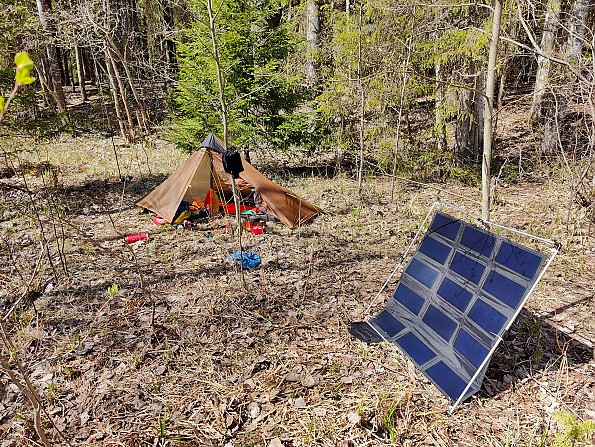
The power output is subject to numerous factors, including your latitude, tree coverage, season, traveling style, and many more. Alaska and California are simply different worlds in this aspect. At my 60°N latitude (much closer to Alaska than I would like) I’ve seen the following figures in early May:
-
In sunny conditions: up to 75 W when precisely aligned to the sun; up to 50 W when laying flat on the ground in midday. With little shadows from tree leaves or thin branches—expect a 30–50% drop.
-
Light overcast (when the sun starts to break through the clouds): about 25 W. Without the direct sunlight laying the panel flat works better than precise alignment with the sun due to the better view of the entire sky, which acts as a scattered light source.
-
As clouds thicken towards a rainy day: 5–15 W.
-
Under dense dark stormy clouds: just 1–3 W.
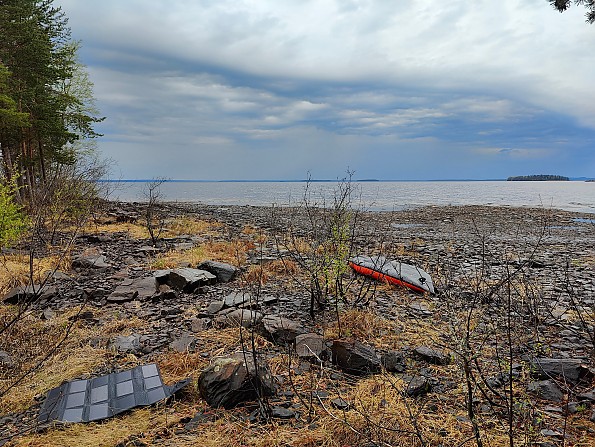
On a recent packrafting trip, I was able to collect 100 Wh during a cloudy day with no direct sunlight (the panel was lying flat from sunrise to sunset). Under direct sun, the output was much higher, especially when aligned properly. On a rainy day, I got no more than 60 Wh. All these figures were obtained without a solar controller (due to its EMI), with a direct connection to my battery—luckily, its nominal voltage matches the panel’s.
It’s worth noting that my measurements (up to 75 W in direct sun) are noticeably higher than those reported in some other reviews (e.g., OutdoorGearLab recorded about 40 W). In my opinion, the result in that test was affected by unfavourable conditions—specifically the lack of a proper MPPT controller and very hot weather, which significantly reduces solar cell performance.
Weight and complexity considerations
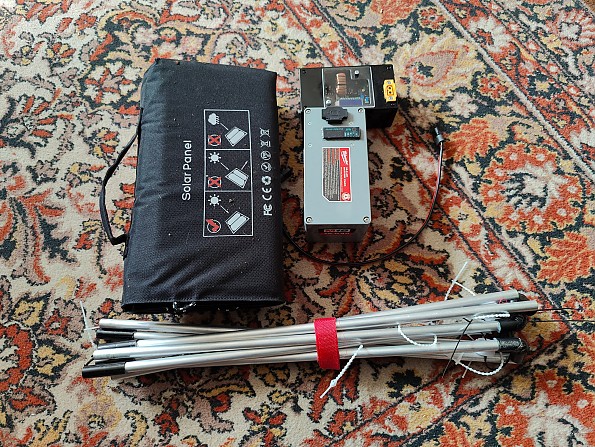
Despite the travel-friendly folded dimensions, the combined weight of the solar power system is quite substantial. Here are the figures measured by myself:
-
Solar panel: 2700 g (6.0 lb)
-
MPPT controller: 337 g (11.9 oz)
-
Battery 250 Wh: 1318 g (2.9 lb)
-
Foldable frame support: 440 g (15.5 oz)
-
10 m (30 ft) of heavy‑duty cable: 360 g (12.7 oz)
Total: 5155 g (11.4 lb)
It equals the Li-Ion battery with a capacity of around 1000 Wh: good for about 7 days of autonomous usage in my case.
Therefore there’s little sense in using solar energy for short trips and/or if your power requirements are modest (no video cameras, drones, high-power radio transceivers, laptops etc.). For a few days trip it’s wise to take just a bigger battery (or additional power banks), where the power supply will be straight-forward and guaranteed.
One must note that an expensive and huge battery is not a good long-time investment though, as it will gradually degrade and lose its capacity. Also such a battery is forbidden for air traveling (so is my 250 Wh battery, of course).
Starting from several days away from the power sockets, the sun power becomes a more viable choice, but still subject to various factors, such as your latitude, traveling style, tree coverage and so on. The assembled 100W solar panel is HUGE—it’s absolutely impossible to use on the go in hiking and cycling trips, but on the boat (a wider one) it may fit fine (if you bothered to make the frame support). Also on the water there’s a good chance that you’ll be able to avoid tree coverage, which renders any solar charger useless.
In stationary camps away from conventional energy sources the solar energy makes an environmentally friendly choice. For car transportation the non-foldable solar panels are preferred over Allpowers SP012, as those are cheaper, easier to align with the sun, and also more suitable for lengthy outdoor operation. But for base camp the point at which a petrol generator becomes more cost-effective isn't far off (discounting the weight, sound and smell). The most lightweight petrol generators are starting from about 10 kg (plus fuel—about 500 g per 1000 Wh).
Verdict
The Allpowers SP012 is a niche tool for long unsupported trips where portability is critical, and power requirements are large, especially if air traveling is involved.
For most other scenarios—car camping, base camps, or short trips—cheaper and better options exist. Where I live, at 60°N, for up to several days away from power outlets, a rechargeable battery is lighter, simpler, and more reliable solution than a complex solar setup. But your mileage may vary—the closer to the equator, the less complicated, heavy and expensive the solar setup becomes.
Speaking of this particular device, its technical design is great, with just a single flaw—DC connector box prone to water ingress. Therefore I confidently give it 4.5 stars.
I wish to express my gratitude to Leonid (shpilev.org) for providing valuable advice and sharing his experience with portable solar power stations throughout the last decade.
Background
Aside from long hours of various experiments at home, I've extensively used it in the 7-day packrafting trip.
Source: bought it new
Price Paid: $195
Your Review
Where to Buy

You May Like
Specs
| Price |
MSRP: $229.00 Reviewers Paid: $195.00 |
| Peak Power |
100W |
| Solar Cell |
polysilicon |
| Efficiency |
23.5% |
| Charging output |
USB & DC5525 |
| Dual output |
94 x 94 x 1 cm / 37 x 37 x 0.39 in |
| Unfolded Size |
32 x 19 x 8 cm / 12.6 x 7.5 x 3.2 in |
| Folded size |
2.15 kg |