
Underwood Aggregator 1 Person Trekking Pole Tent



 Reviewed by
wallace biggs
TOP 25 REVIEWER
+319
July 27, 2026
Pretty good shelter; easy to pitch. Light, well-made. Probably best for people of medium height or less. Great for anyone wanting market-bottom price for competitive functionality.
Pros
- High function
- High value
- Quick pitch
- Capacious headroom
- Seam-taped
- Well constructed
- Terrific ventilation potential
Cons
- Elusive taut pitch
- Tilted pole
- Small footbox
- Too-large door
- Large WOWS
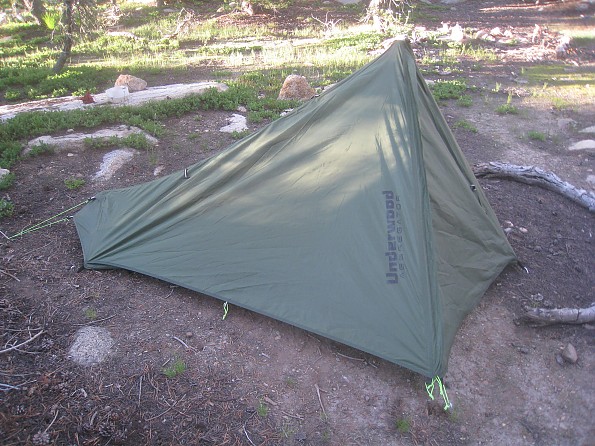
This Underwood Aggregator is a single-wall, coffin-shaped, floor-pegged solo tent using a trekking pole for primary support and an integrated 11" length of aluminum tube for foot-end support.
On very short notice I needed a new tent for a 9-day trip and shortly thereafter a 4-dayer, both in Emigrant Wilderness (adjacent to Yosemite). After a quick surmise of what's available in the category, I flashed across the UA online and bought it with that much thought. It’s under 2 ½ lbs, arrived on the porch two days later at about the cost of a one day rental. I was thrilled. I love stumble stick tents and I really wanted to love this one. Can’t make one for its price; and saved me the effort.
THE CHASE: Some design features make little sense to me, but it’s dirt cheap and works pretty well.
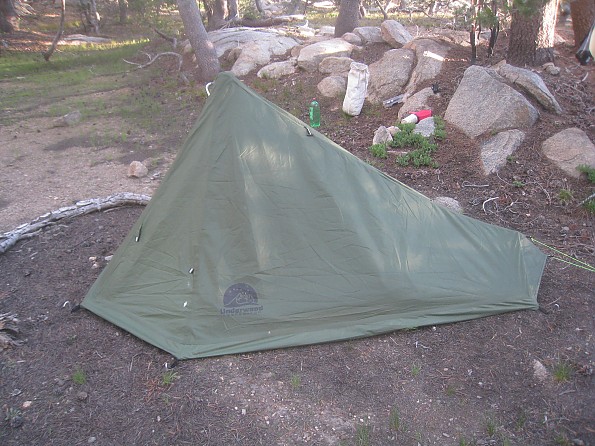
I find the tent very well constructed: Impeccable sewing; reinforced stress points; seam-taped and waterproofing to a claim of 5k mm. Seven peg points pitch the tent with only one required guy line to trip over. Four optional guy-outs. Pocket secures the pole handle at top and a metal tab fixes the tip point in place at the bottom. Simply peg out 5 floor points; insert the pole and with the head end vestibule flap, pull the pole into position and peg the flap; peg the foot end apex. Incredibly easy to get shelter.
To get a taut pitch however, I never could in 10 tries. Something in the design geometry evidently got missed in CADing and prototyping; though user error should not be too quickly dismissed. I know from my two others that pole length is critical and I could not find a length that worked within the parameter established between the handle pocket and tip tab.
Floor-guy pegging makes the tent easier to pitch (and less expensive to make), but creates much Wedge Of Wasted Space; in this tent on the right side and foot end. (Alternative "hanging tub" design can eliminate WOWS, but is more complex to build and pitch.) The 3 panel guy-outs did not prove helpful; and I never had occasion to try the 4th (peak) to an overhead anchor. I think a guy-out in the center of the long side panel might actually be helpful.
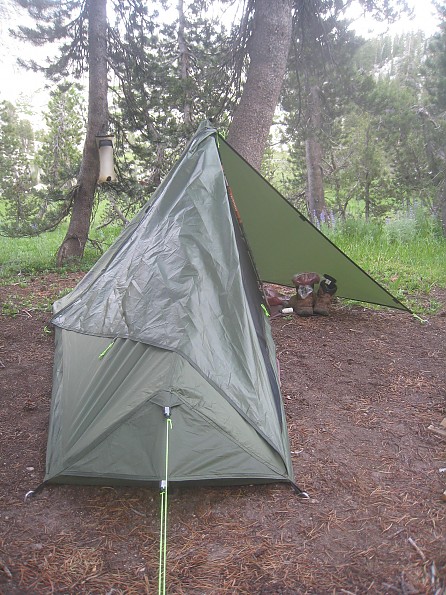
Pole tilt strikes me as curious. I’m guessing the idea (along with the short-integrated-pole-supported apex at the foot end) is to approximate a pup tent shape. Don’t see many of that ancient design anymore and to my liking it does not at all suit a solo pole tent. The A-shape forces user to sleep in the center of the tent. This isn’t so much problem at the head end where there is a lot of space and very little WOWS.
At the foot end, toes are to the left and right of the apex and heavily contact the ceiling. Any moisture that builds up will necessarily soak into the blanket or bag. Perhaps I don’t find that a poison pill yet as enough moisture never developed; and I'm mostly a side-sleeper. The tent met with only two very brief encounters of intermittent sprinkles, and no heavy humidity.
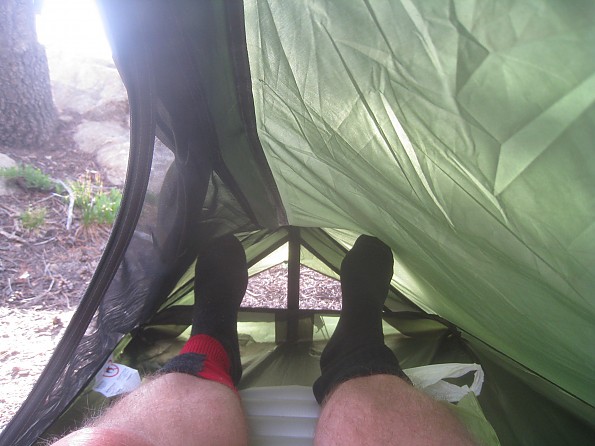
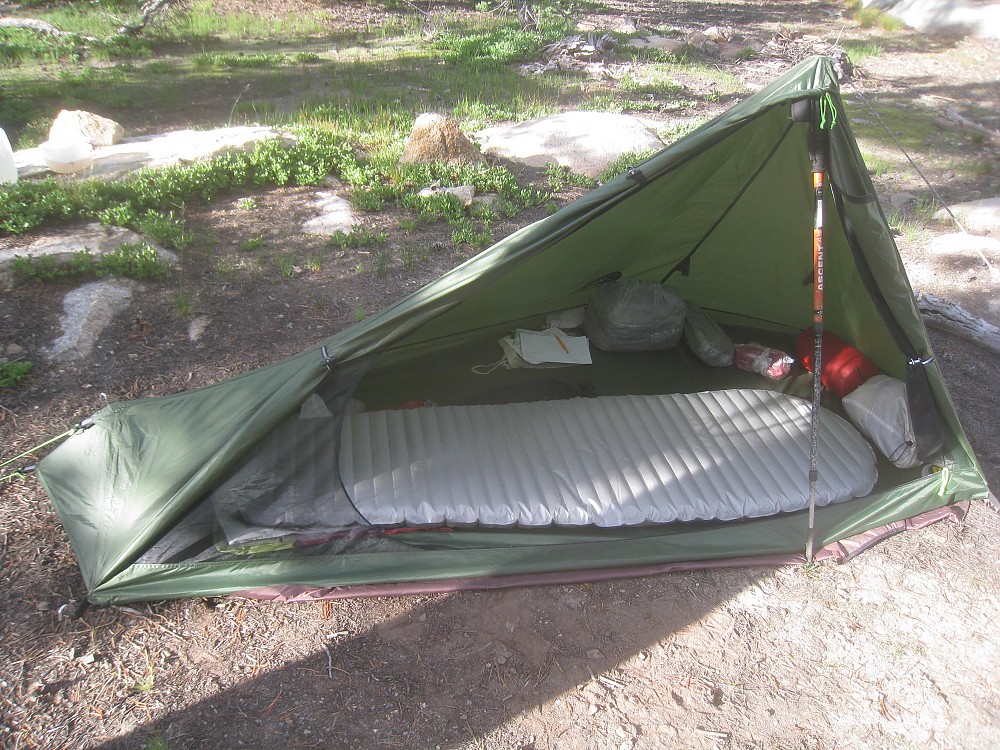
Door comprises nearly the entire side of the tent for great ventilation and viewing. For a completely unobstructed view, the door stows at the head/left corner to leave virtually the entire side open. With the pole handle guy loop (peak) line-pegged instead of using a vestibule flap, both flaps and the door can be rolled up and stowed, providing about a 90° unobstructed view of the outside.
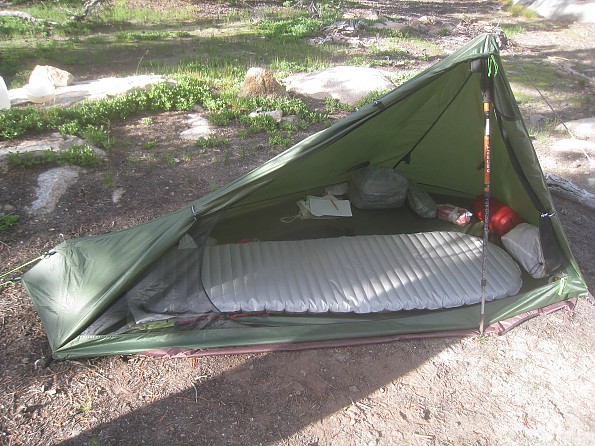
Zipper is very smooth. Two zipper pulls conveniently allow adjustment of how much of the door to open, but even then there is too much zipping, with the foot-end turn requiring body repositioning. I would much prefer a reverse D-door of a foot or so less from the foot end; and that stows against the pole, with fixed netting from the pole to the head end. (Such a fixed panel would beg for addition of a gear pocket, which this tent does not have.)
Inward tilt of the pole exposes screen or open tent to the sky, so that any dew or rain drops fall through / in. Preventing this requires zipping the vestibule, which then very nearly eliminates ventilation. The patch of screen at the foot cannot get the job done. One big advantage of a (vertical) pole tent is leaving the side open for ventilation in rainy weather; and I don’t see enough benefit to trading away that advantage.
In my experience, any tent can have condensation issues, which can be mitigated by ventilation. Staying bone dry in damp/wet conditions requires stringing a tarp; which I’d suggest generally applies no matter the design or cost, especially for a small single-wall tent.
UA’s vestibule provides generous exterior shelter, though I kept everything but shoes inside. I did use the head-end flap all the time. Deploying the foot end flap made the interior clam up fairly quickly; and were the only times I had any detectable condensation. I would prefer a half-flap that would reduce covered area, but allow more ventilation while still shielding inward-leaning netting. Whether an anomaly or a bad batch, the vestibule zipper is chronically balky no matter the vestibule being deployed or laid out flat and unstressed. (Zipper cover can snag, but that is different from a cranky zipper.) If I’d paid hundreds I’d return it for this reason. For what it did cost, I may bother to sew in a new zipper.
One of the foot-end vestibule flap retaining loops conflicts with the door zipper and though this is relatively minor it also seems unnecessarily sewn into the zipper tape instead of the material above it and out of the way.
Pitched pole holds securely in place with surprising rigidity, though two-way tilt denies any option of non-pole length adjustment. By coincidence my two other polers required the same 46” length as the UA; and my pole is torque-locked at 43”. I hate to loosen it at all, let alone twice a day. (I don’t trust it to hold anew.) The tilt does not accommodate using a chunk of rock to make up the length. (Non-vertical pole skids out under pressure.)
Canopy weighs 29 3/8 oz; 13-peg (I carried only 7) / 2 guy line pack with stuff sack 7 5/8 oz; stuff sack (not carried) 1 1/8 oz. Easily rolls to about 14 x 5 inches. Does not come with footprint and none appears to be available; I snipped one out of a retired tent tub.
A tent must suit the user to be worth whatever the price. This tent costs a pittance and provides good shelter and many benefits. It resides in a weight range with bivies and certainly offers substantially more accommodation. The tent has some design quirks; but compare its issues to any other tent on the market and feel even better about its bottom-of-the-market price.
Background
146 nights in two other solo trekking pole tents and 11 in this one. 2 trips; 10 pitches. Warm weather backpacking. I have no connection to the mfr or vendor and was not asked or compensated for the review.
Source: bought it new
Price Paid: $36 + tax; free delivery
Your Review
Where to Buy

You May Like
Specs
| Price |
Current Retail: $43.99 Reviewers Paid: $36.00 |