
Garmin Vivosmart



 Reviewed by
Vladimir Gorbunov
TOP 10 REVIEWER
+3,273
 December 21, 2017 (original Aug 28, 2017)
A multi-functional health tracker combining wrist-based heart rate monitor (HRM) with ANT+ broadcasting capability and simple smart/sports watch abilities. Nice device for those who are tired of chest-based HRMs. Unfortunately the feature set is very limited in comparison to true smart/sports watches.
Pros
- Heart rate broadcasting feature via ANT+
- Some sort of smart watch features (receives notifications, calls and weather forecast, controls music)
- Fitness tracking features with 24x7 pulse monitoring, sleep graph, steps, stairs etc.
- Automatic recognition of sports activities
- Good web- and app-based health statistics
- Very comfortable to wear (and lightweight)
- Decent battery life in its class
- Affordable
Cons
- Doesn’t show current time and notifications during HR broadcasting
- Wrist-based HRMs are less accurate and have much less battery life than chest-based ones
- Only single alarm clock with limited features and insanely awkward setup via phone app
- Has limited use as a sports watch due to limited list of activities and lack of GPS
- Annoying vibrating motor
- Cannot be set as a “trusted device” for unlocking the phone automatically
Background
I’d been using the chest-based HRM with my old Garmin GPSMap 62s in 2011-2013. I liked the possibility to examine my pulse during the rides, especially the reaction of my body to various difficulties during the trip. For example, during the ford crossing in Iceland (I described the situation in this article), when my bike and gear were almost washed away, the heart rate jumped very noticeably. Also knowing the heart rate may prevent extreme exhaustion and possible damage to the heart.
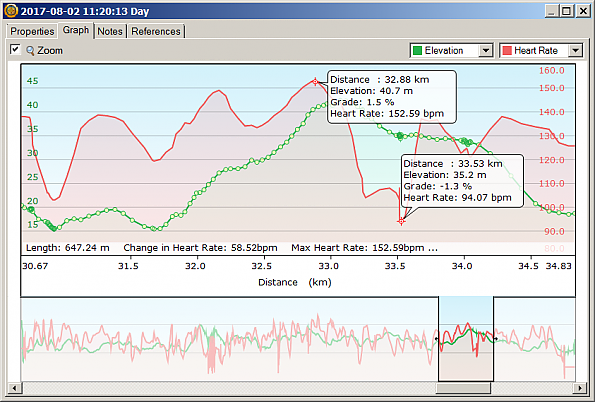 Heart rate vs. elevation (in meters) graphs in Garmin Basecamp app
On the other hand, during my 2-week trips wearing the chest strap was very uncomfortable, especially when putting it on in the tent in the morning, the strap being cold and sticky. During the riding the feelings weren't good as well — the strap was either too tight, or it had tendency to crawl down. So after two years I stopped using the chest-based HRM and sold it.
Not so long ago I learned that some fitness trackers with integrated HRM are able to broadcast the pulse data via ANT+ protocol. That makes such fitness tracker effectively a wrist-based heart rate monitor. Notably, the Garmin fitness trackers, sport watches and also fitness trackers from Mio brand are able to do that. The latter were not a choice due to poor battery life in broadcasting mode — just 8 hours (a wrist-based HRM consume much more energy than a chest-based).
So I decided to buy the cheapest available Garmin unit — Vivosmart HR with claimed 24 hours in pulse broadcasting mode (unlike the HR+ variant, it doesn't have the embedded GPS).
Overview
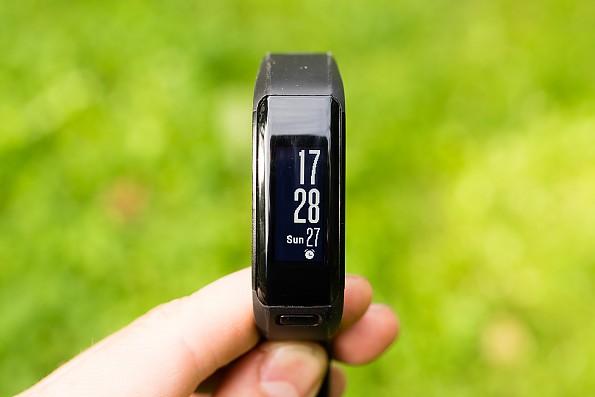
The Vivosmart HR tracker has a touch-sensitive always-on display with backlight and a single physical button. It has 5 ATM WR rating, which makes it suitable for all water activities except the scuba diving and high-speed watersports. There are two sizes of silicone band (non-changeable) — regular and large. The watch weighs just about 30 grams (1 oz), and that makes it almost unnoticeable on your wrist — it feels like a good glove when properly adjusted. The full-sized watches are much bulkier and less comfortable to wear.
The feature set is limited in comparison to both “smart” watches and sports watches, but still it has some settings to deal with, both from device menu and Garmin Connect phone app. During the day the tracker performs periodical monitoring of your pulse and movement — the more activity it detects, the more often it measures your pulse (which consumes the battery).
When starting a sports activity manually (the choice is narrow: walk, run, “cardio” and “other” — I never use this feature), the tracker begins displaying pre-set parameters (such as current pulse, HR zone, time and so on, only two parameters at once) and recording your data. Also it can detect and recognize your sports activities automatically, with ability to review them later.
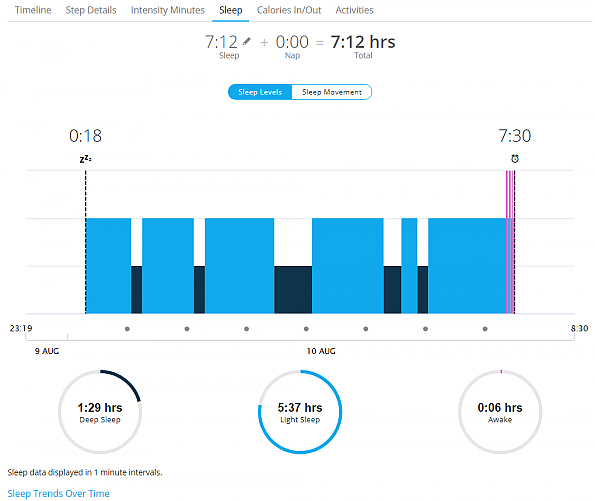 Sleep monitoring in web-based Connect app — actually I woke up at 7:05, but remained in bed until 7:30
Due to lack of GPS, the speed and distance are not monitored (except for crude estimation while walking or running), and unfortunately the device doesn’t get GPS data from the phone. Talking about the fitness tracker abilities, it’s worth noting its ability to count the stairs, steps, and burnt calories. Your sleep is also monitored, but not very reliably (it tends to miss the actual waking up). All collected data is displayed in web- or app-based Garmin Connect monitoring service with exceptionally rich set of features and monitored parameters.
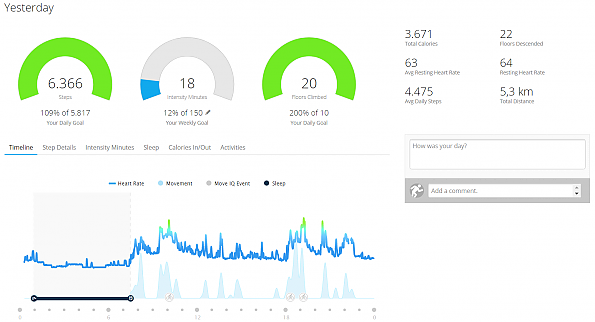 Daily physical activity review in Connect app
The “smart” watch abilities are limited to displaying the simple weather forecast, calls and message notifications from your phone, and also controlling your music player (the most basic set of controls, the song name is not displayed) and Garmin Virb camera. This may be well enough for most people.
Sadly there is only a single alarm clock with very limited settings (runs either daily or Mo-Fri). The alarm clock can be adjusted or turned on/off only from your phone and only if you have Internet access (expect extra costs in roaming). Even if your phone says that the settings are saved, you need to initiate sync process from the tracker to be sure that you’ll wake up at time tomorrow. Small doubt that it’s purely a software limitation for directing the potential buyer to more expensive “true” sports watches or at least a bit more advanced Vivosmart 3 model.
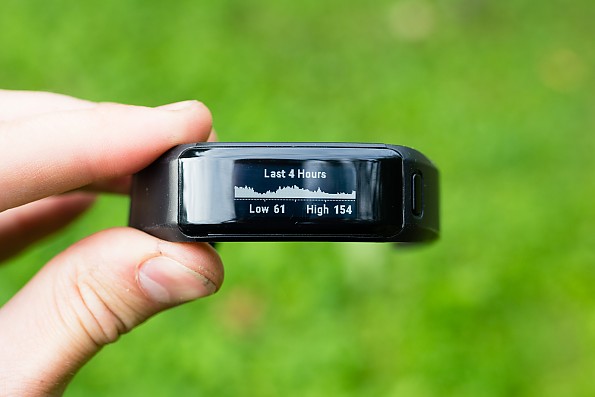
Displaying the pulse graph is an alternative option at "Pulse" screen (e.g. at "Weather" screen the alternative option is displaying the forecast for 4 days)
One more complaint — due to weird Bluetooth connection protocol (the connection is made inside the Garmin app), this tracker is not visible in the list of paired BT devices on your phone and thereby cannot be set as a “trusted device” for automatic unlocking the phone. On the other hand, the BT connection re-establishes virtually immediately if you were outside the range for some time. My old Pebble Steel took much more time for re-connecting to phone, and not always successfully.
The vibration motor on Vivosmart HR is overly powerful, thus all alarms and notifications are extremely annoying.
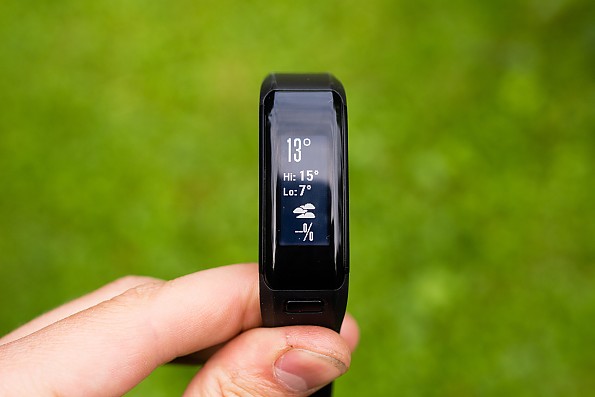 Simple weather forecast
The manufacturer’s claimed battery life is about 5 days for typical usage and 24 hours for HR broadcasting. To my opinion, it’s quite fair number, and it may change in dependence on your activities (the more sports activities you do, the less the battery life). After 2-day family cycling trip (48 hours in working state, including about 6 hours of pulse broadcasting) I still have around 50% of battery remaining. The modern Android-based smart watches suffer from tiny battery life — you're lucky if you get beyond 2 days with such kind of watch.
Heart rate monitoring
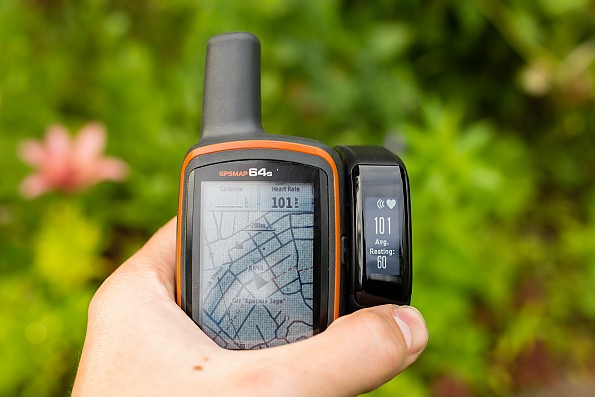
This photo was made for illustrational purposes: the monitor continues displaying some values after removing from wrist. Though the blinking heart icon indicates that these values aren't reliable.
This fitness tracker was purchased primarily as a wrist-based HRM for my bicycle rides. In that it proved itself extremely useful. After swiping to HR screen on the tracker you tap and hold the finger on the screen until the monitoring prompt appears. After tapping on YES the tracker begins constant monitoring of your pulse and broadcasting it via ANT+ to compatible device (such as my Garmin GPSMap 64s which displays the current HR and records it to the track). The screen of the tracker may be locked by long pressing the physical button to avoid accidental switching the mode.
Unfortunately the display doesn’t show ANYTHING but current pulse (and completely useless average resting pulse value) during the HR broadcasting. And notifications are also not received. Notably, the 5 times more expensive Garmin Fenix HR sports watches suffer from the same problem, but they can display the time at least! It’s reported that Vivoactive HR sports watch is able to work normally during the broadcasting.
I experienced periodical losses of ANT+ signal in various situations, but almost never — while riding the bicycle.
UPDATE: these signal losses were caused by a bug in my Garmin 64s unit firmware, which periodically interrupted the receiving of ANT+ signal, if it couldn't find the paired Tempe sensor. Now I disable the Tempe sensor in menu (when it's not present), and everything works fine.
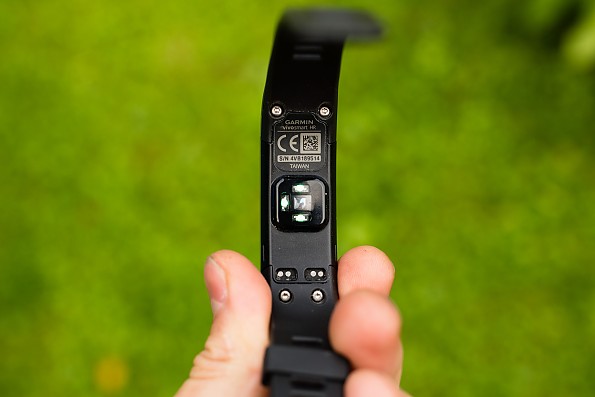
Generally the accuracy and responsiveness of wrist-based pulse monitors are worse than that of chest straps. The latter also have 100 times more battery life (measured in years vs. 24 hours) due to fundamental difference in measuring technology (green LED+optical sensor vs. electrical receiver). Nevertheless the Vivosmart HR displays quite reliable data with good correlation e.g. to elevation graph. So for entertaining and general information purpose it’s still a good option, if taking the exceptional wearing comfort into account. Of course, for serious athletes (especially the swimmers) the chest-based HRM is still the only choice.
Note: the Vivosmart-series trackers don't support any external ANT+ sensors, you’ll need a proper sports watch for that.
Conclusion
This tracker has left mixed impressions. On one hand, it’s good at what it was purchased for — measuring the pulse and transmitting it to my GPS unit. Its low price and extremely high wearing comfort also make me very satisfied. On the other hand, the feature set is very poor in comparison to “true” smart/sports watches.
I especially miss the ability to set multiple alarms from the watch, like on my old Pebble Steel. Unfortunately for more alarms (eight) I should have purchased Vivosmart 3 tracker, which in turn doesn’t have an always-on display! So the ultimate choice is difficult.
Nevertheless this device is generally fine for its money, especially if you purchase it in refurbished state, like I did.
Source: bought it new
Price Paid: 60 USD (factory refurbished)
 Reviewed by
Ianw
+782
 August 24, 2017
The Garmin Vivosmart HR+ is definitely not perfect, but packs a lot of useful features into a relatively compact package.
Pros
- Lots of features
- Smallish size
- Good screen
- Waterproof
Cons
- Poor battery life
- Poor sleep tracking
- Questionable durability
- Proprietary charging cable
- GPS accuracy not great
- Floors climbed statistics are nonsense
I have been using the Garmin Vivosmart HR+ for about a year now, mainly for day-to-day health tracking and hiking. Here is a summary of what I think is good and bad about it.
Pro
Features: Provides lots of features including step count, heart rate, GPS tracking, sleep monitor, Bluetooth connectivity, notifications from phone and control of music on phone (I don't use this).
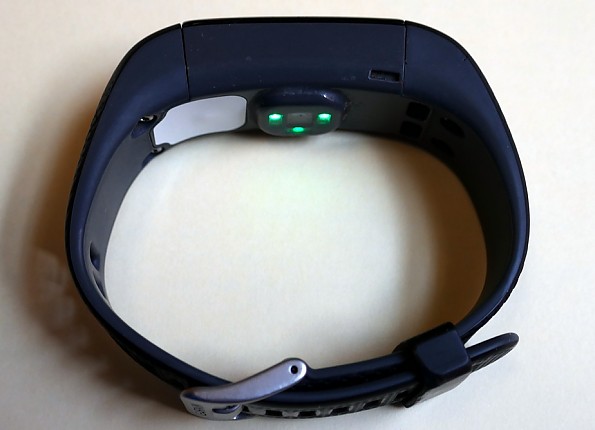
Size: The Vivosmart HR+ is fairly small, not all that obtrusive though not as small as some others. It is much thicker than a watch (photo above) so with some shirts I find it gets stuck under my sleeve.
Screen: Screen is always on and backlit. It is clear, large, easily read and customisable to a certain extent.
Waterproof: Claimed to be waterproof to 5 atmospheres (about 50 m). I have used it snorkeling (about 3 metres) and it was fine except that the touch screen does not work when wet.
Logging: Logs all sorts of things, some accuratly (steps), some not (sleep and heart rate). I find Active Minutes especially useful. Some of the records are only available via the Garmin phone App which requires a Garminn account (free).
Con
Battery life with GPS on: Garmin claim 8 hours but I have tested it a number of times and it is consistently around 5 hours 43 minutes, only 71% of Garmin's claim. As I use it for hiking, this is not really enough. Without GPS tracking on, the battery lasts half a week at least.
Sleep tracking: If, like me, you wake during the night, it will record movement but cannot tell that you are awake. i.e. it only records one lot of sleep a day. The result is my recorded sleep is longer than I actually sleep. Sleep monitor is pretty useless for me.
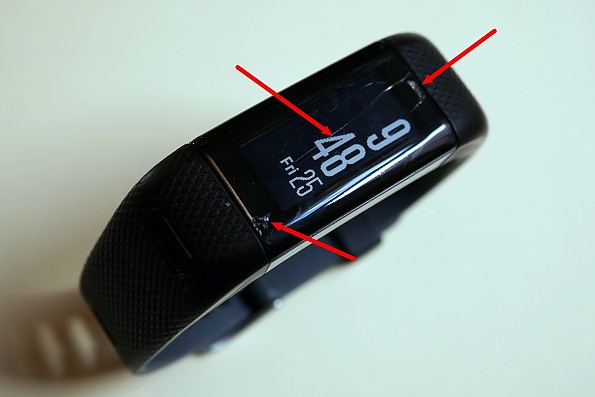
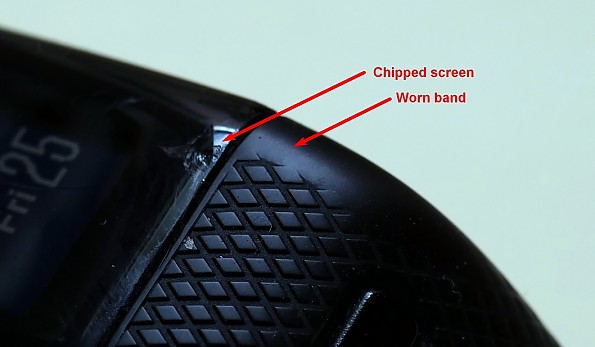
Durability: I have concerns about the durability of the Vivosmart HR+ especially given that it seems intended for physically demanding uses (e.g. the 5 atmosphere water resistance). The screen on mine somehow got cracked (see photo). I have no idea how this happened as I can't recall any hard impacts.
Also the pattern on the band is wearing off (see photo) suggesting the band might not last long. All this after just 12 months. These is a concern as the teardown of the similar Garmin Vivoactive on the iFixit website shows it not repairable. A device costing over $300 should not be throwaway.
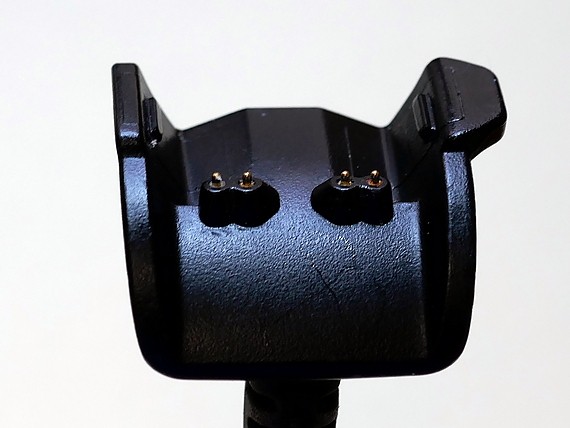
Charging cable: Ugh, it's awful! The Vivosmart HR+ uses a proprietary cable that is hard to attach properly. Although it charges quite fast, it is not unusual to find it was not attached properly and the thing has not charged at all. Plus there is the problem proprietary cables if the battery goes flat while I am out, say due to GPS use, I cannot charge it till I get home. A waterproof standard USB socket would make much more sense.
GPS accuracy: Don't expect the accuracy of a full size GPS. It is not unusual for the Vivosmart HR+ to add a kilometre or more to a hike. The Vivosmart HR+ is more like GPS on a phone—usable but not great. (I use it with GeoSetter to geotag photos as my camera has no built-in GPS.)
Floors climbed: This is inaccurate nonsense, but I suspect the same is true of other fitness trackers and phones that use so called "floors" to measure elevation gained. A floor in a building is 3 to 4 metres but when I have checked values given by the Vivosmart HR+ against a more accurate device (Garmin Montana 680t) a "floor" can be up to 10 metres.
Garmin say nothing about how floors are measured so I guess they (and others) use it to hide the fact that the device doesn't measure elevation change accurately. If it does, how about giving us the option of metres or feet?
Overall
The Garmin Vivosmart HR+ is definitely not perfect, but packs a lot of useful features into a relatively compact package.
Source: bought it new
Price Paid: $AU 328
Your Review
Where to Buy



You May Like
Specs
| Price |
Current Retail: $149.99 Historic Range: $53.99-$149.99 Reviewers Paid: $60.00 |