
Durston X-Dome 2



 Reviewed by
BigRed
TOP 10 REVIEWER
REVIEW CORPS
+10,775
November 2, 2025
An ultralight, freestanding, and relatively roomy 2-person tent with double entries and vestibules and plenty of headroom. Cutting-edge silpoly fly and floor and carbon fiber poles. Versatile pitching options help with fast setup and keeping dry.
Pros
- Freestanding
- Ultralight (for a freestanding tent)
- All-in-one, fly first, and fly only pitch options
- Dual entry
- Double-wide doors on fly and inner
- Solid inner tent option
- No-sag silpoly fly and floor
- Ample interior space and sit-up room for two
- Magnetic door holders
- Straight, smooth, snag-free zippers
- Trekking pole bracing in high wind
Cons
- No fast way to pull the fly over in case of unexpected rain
- Low bathtub floor
- Vestibule area not all useable
- Separate pole anchors (could click together)
- Only one low-level pocket at each end
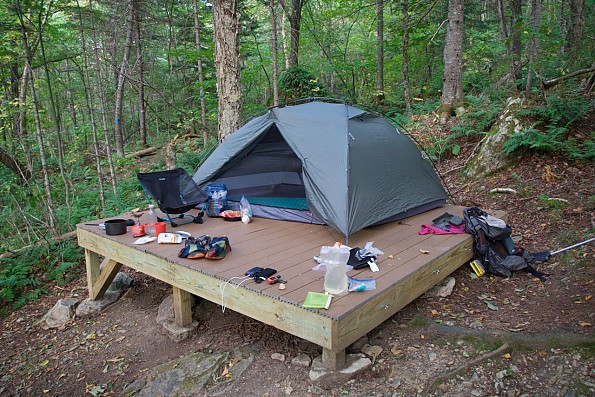
With our 450-mile (725 km) section hike on the AT in the works, it was time to lose some weight. Not body weight, though that might happen anyway, but gear weight. Like, maybe a new tent? When it comes to tents, we've have had a lot of back and forth over the years, with me pulling for lower weight (I always carry the tent) and Waffle (my lovely wife’s new trail name) arguing for space and livability.
A few years ago we tried a Tarptent Stratospire 2 Li (31 oz / 880 g), but we both felt it was too claustrophobic so we sold it off. Our Hilleberg Anjan 2 GT, is roomy and great for Scandinavian conditions, but it’s heavy at about 4.8 lbs (2.2 kg with stakes and stuff sacks, etc.) and requires an extra-long tent site. Our 2017 model Big Agnes Copper Spur HV UL 2 is light enough (ca. 3 lb, 1.4 kg) but a bit tight on sleeping space and the curved zippers were acting up after being used on several months’ worth of weekenders and longer hikes from desert to tundra.
So what’s an aging but eager couple to do? We took a long hard look at the Durston X-Mid 2, which would surely have saved a lot of weight but looks a bit fiddly to set up, especially on the tent platforms we would encounter on the AT, and like the Stratospire the sloping head and foot ends looked a bit too close for comfort. So we were very interested when Durston announced the X-Dome 2 for availability by early summer 2025. It’s an enlargement of the X-Dome 1+, introduced in 2024, with all of the same features but room for two. We eventually pulled the trigger, and had it sent to a friend in New England where we could pick it up before setting out on our Big Adventure.
As it turns out, it doesn’t have much of a weight advantage over the Copper Spur, but it does offer some practical advantages that we really appreciated in 50+ nights in the tent. (Because Waffle had to go off trail with foot problems, I ended up using the tent solo for a month or so.)
Materials and weight
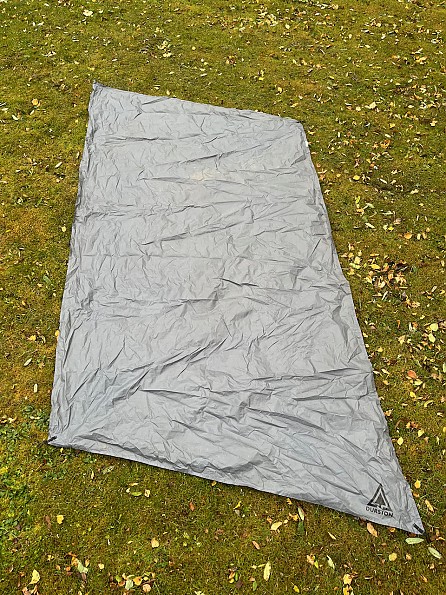
Durston’s “typical setup” weight (with 6 pegs) is 47 oz (1335 g), but it comes with 8 pegs so it seems wise to carry all eight to be sure I can keep the tent stable and dry and wind in rain. I managed to rip the main stuff sack early in the game—the lightweight fly and floor material is also used for the stuff sack and it didn’t handle the pushing and pulling all that well. I ended up replacing it with an uncoated roll-top sack I found in a hiker box. I also opted to carry the footprint (3.6 oz, 146 g; weights given for other tents above are without footprints). So I ended carrying a whopping, but honest, 54 oz (3.4 lbs, 1535 g). That's 1.7 lbs (766 g) per person.
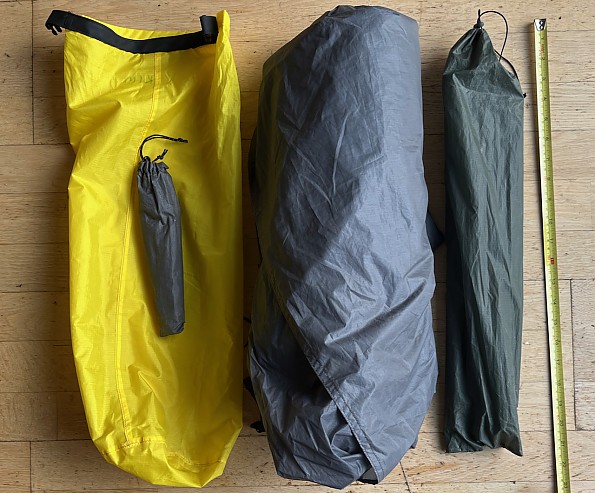
The tent is a loose fit in the bigger stuff sack and so ends up a bit bigger in diameter than Durston's packed size spec (17.5" x 5" / 45 x 13 cm) but takes less pack room than any of our other two person tents. I like to fold and roll rather than stuff, especially when packing up the tent an all-in-one mode.
The floor and fly are made of 15D ripstop polyester double-coated with silicone and polyether urethane to allow seam taping. Durston notes that this material will not sag when wet, as happens with nylon, and my experience confirms this. Having weathered both heavy thunderstorms and all-night rain, with some ground flow under the floor, I can also vouch for its waterproofness. It has a slippery and crinkly feel compared to PU-coated nylon. The floor and fly seams are all taped.
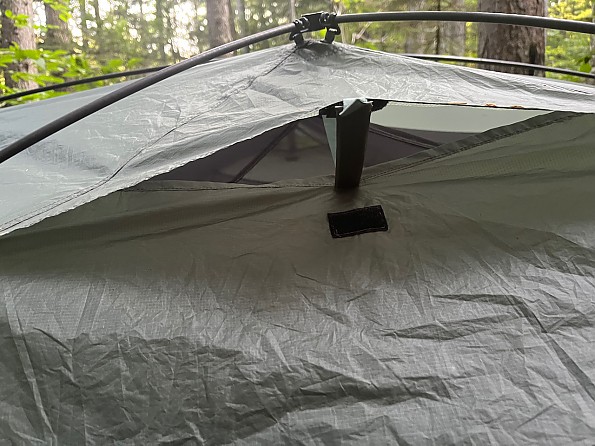
The bathtub floor extends up only about 4" (10 cm). I would appreciate another inch or two, and/or a fly that extends closer to the ground, to deal with splash-up from the fly edges during those heavy thunderstorms. A pair of vents with hold-opens at the ends of the spine help vent excess vapor. I've had some mostly condensation-free nights in cool-dry conditions, but like any tent condensation can build up when rain or heavy dew collects on the fly.
Above the bathtub floor, the inner tent canopy is mosquito netting, excepting solid ripstop panels extending up about 6 in (15 cm) at the head and foot ends and around onto the shorter of the two door panels at both ends. Having had fine sand and dust blow in through the netting of other tents without this protection, I’d appreciate a full and maybe higher wrap-around solid panel, but then maybe I should have just gone for the solid inner tent. That option has two mosquito netting triangles at the top of the doors to let some fresh air in and vapor out but is otherwise all solid ripstop. WIth a tougher 20D silpoly floor, the solid inner weighs 3.5 oz (100 g) more.
The pole architecture is similar to other current generation freestanding tents like the (original) Big Agnes Copper Spur or MSR Hubba tents: two wishbones joined by a central spine, with a crossbar across the middle. In the X-dome, these are all joined into a single unit by shock cord and hubs. Nothing revolutionary there.
But Durston steps well outside the box by using carbon fiber poles in two diameters, 3.9 mm for the four legs and 6.3 mm for the spine and crossbar. The bigger diameter puts strength where it's needed most. The full pole set weighs in at 11.6 oz (330 g). An optional, more compact short pole set (13"/33 cm vs. 17.5" /45 cm) weighs 12.9 oz / 365 g.
For those who aren’t ready to commit to carbon fiber or want to save some money, Durston has also introduced an aluminum pole set weighing 17.4 oz /495 g. The pole set has held up well for me under extended use and for other reviewers using X-Domes in more windy conditions.
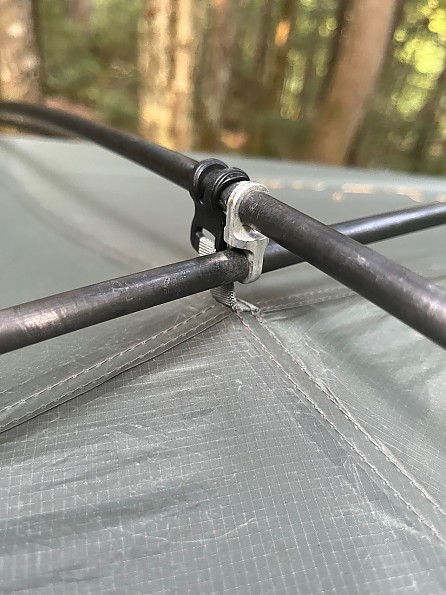
The spine and crossbar meet at a rigid aluminum fitting. The ferrule on either the crossbar or spine has to be pulled out of the fitting to fold up the poles. I wonder if a rotating version of the fitting would make life a little easier by allowing both ferrules to stay with the fitting.
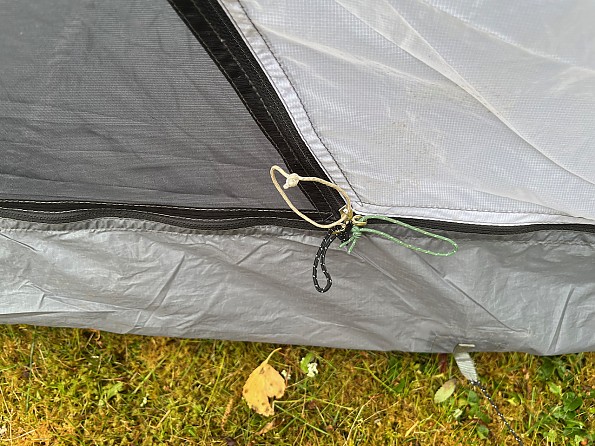
The doors open using three separate YKK #3 zippers, and the fly opens using YKK #3 coated zippers. All zippers operate smoothly, I think because they are all straight so there are none of the stresses associated with curved zippers. That should also help them hold up longer. The coated zippers kept out even the heaviest rain I experienced on the trail, with no cover flaps to jam the zippers when opening or closing, a pet peeve of mine.
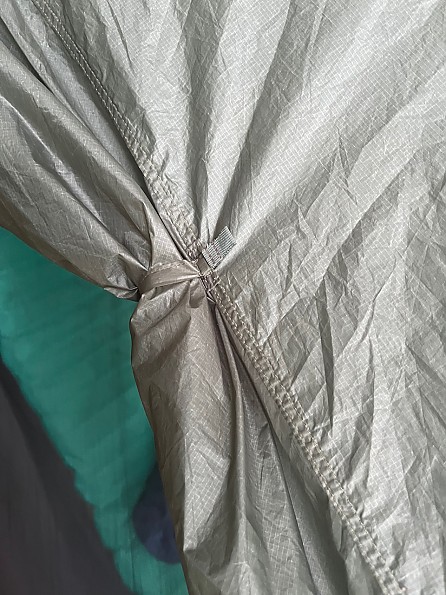
The magnetic door ties are a small but significant blessing. No fiddling with knots or toggles in the event of a midnight rainfall, just tug free and zip. Why don’t all tents have these?
Although the X-Dome 2 can be deployed pegless in freestanding mode, in most situations it’s a good idea to anchor the corners or pull out the midpoints of the fly, with the number and weight of pegs taken along decided according to expectations.
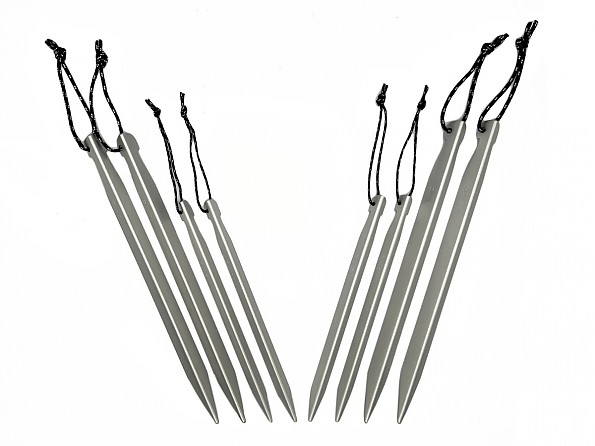
The tent ships with 8 DAC aluminum pegs, 4 each of the 6-inch (15 cm) and the beefier 8-inch (20 cm) lengths, at about 0.25 and 0.6 oz (7 and 17 g) each, respectively. That includes the pull loops of reflective cord provided on all 8. They help not only in pulling recalcitrant pegs, but in finding stray pegs by headlamp in darkness or low light. These are the same type of peg that I have used on my Big Agnes tents for years, in everything from soft forest duff to hard desert caliche, without ever bending a single peg. Good choice.
The 8-inch pegs are probably overkill in less-demanding situations, and so could be left behind or swapped out for lighter pegs to save a few oz / 10s of grams. In high winds both the big pegs and 2 to 4 extra pegs (up to 15 total according to Durston) might be needed for guying out the ends of the tent, even when bracing with trekking poles (see below).
Living space
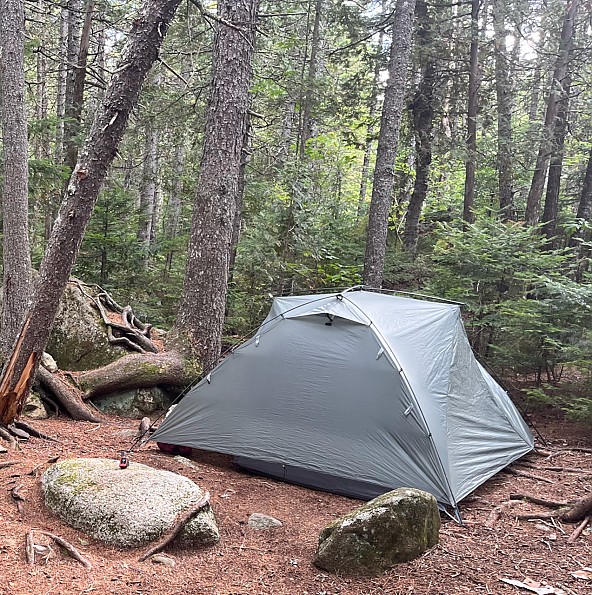
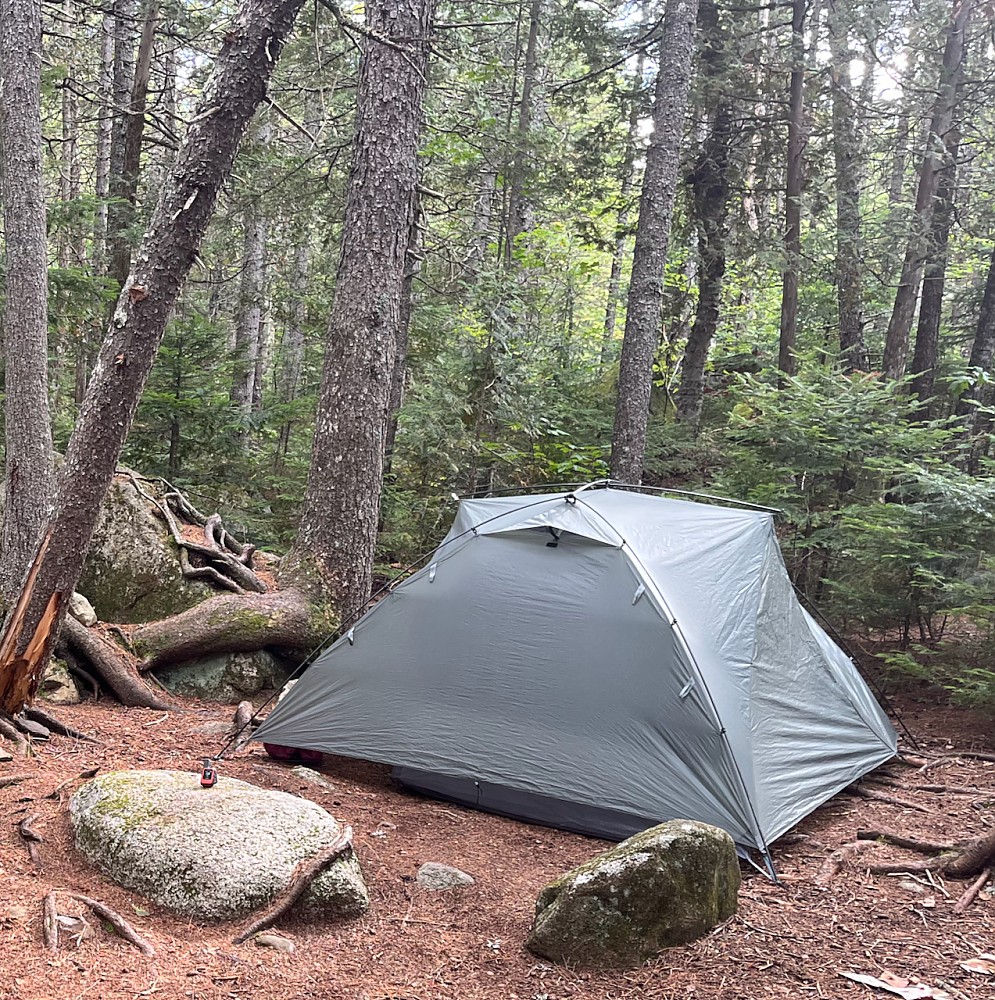
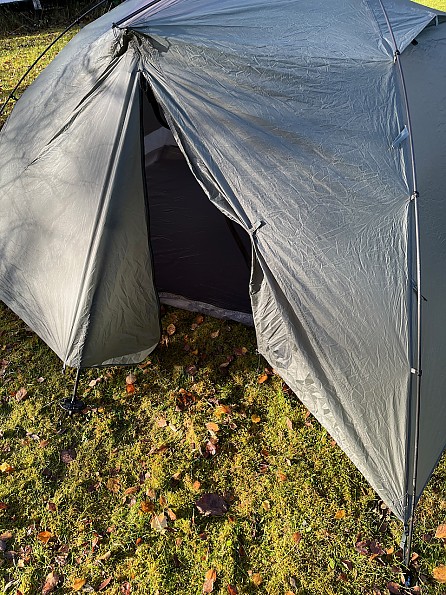
From the outside, this tent is plain vanilla—or maybe olive. The footprint of the fly is a simple 87 x 79" (2.2 x 2 m) rectangle, and the plain green color is about blending in rather than standing out, in keeping with the philosophy of an old outdoor mentor of mine. But the external poles are certainly out of the ordinary; most dome-style freestanding tents put the fly over the poles.
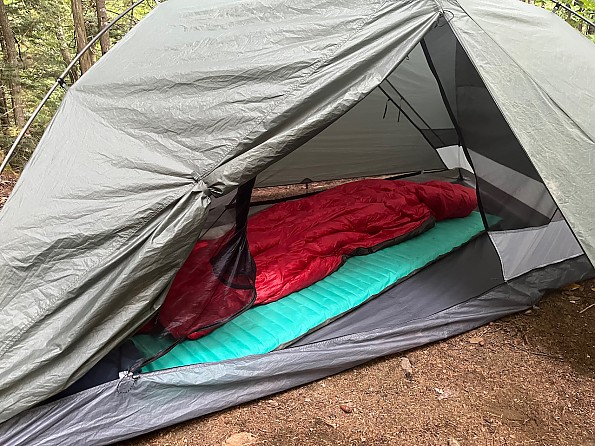
One or both sides of the fly can be docked open, to either open up to the elements or leave a wind and rain shield for gear or out-the-door cooking. Even with both open, the fly extends past one corner of the inner tent to offer some shelter from the wind. The crossbar spreads the fly out over the doors to form a minimal awning, enough to allow keeping the fly partially or fully opened up in a light rain.
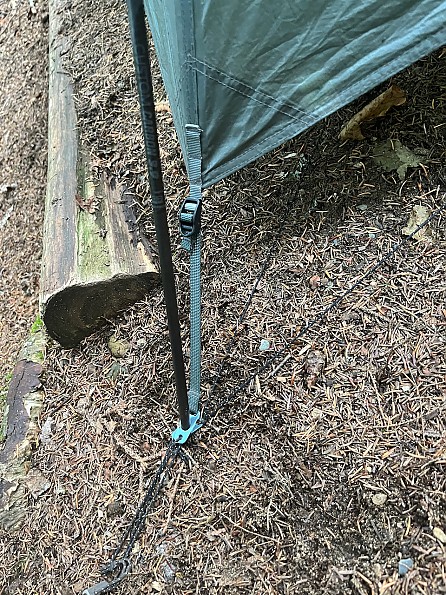
The poles on two, diagonally opposite corners of the fly hold the fly out about 25" (63.5 cm) beyond the equivalent corners of the inner tent, which are joined to the pole ends by a pair of cords on each. I’ll call these floating corners.
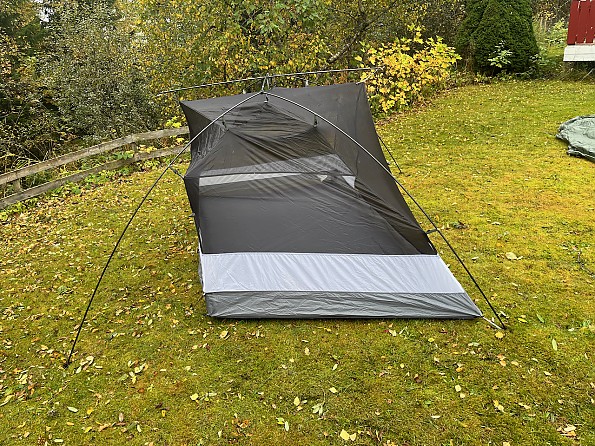
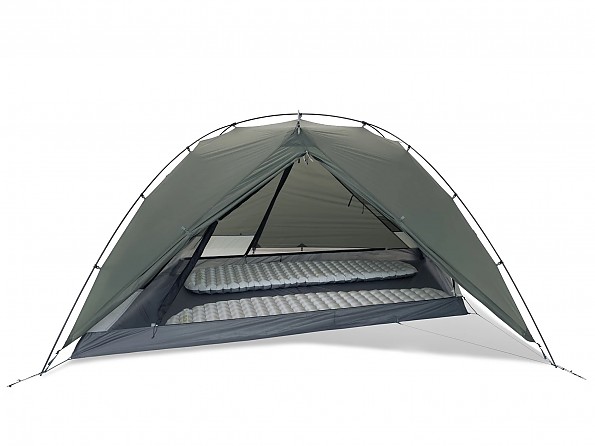
The inner tent looks oddly asymmetric when set up without the fly, with the poles extending well beyond the floating corners. But that provides vestibule space (2 x 9 ft2 / 0.85 m2), widest at the floating corners, providing space for stashing packs without blocking the doors. The vestibules taper down to the other corners so there isn’t room for much more than a pair of shoes on the other side of the door.
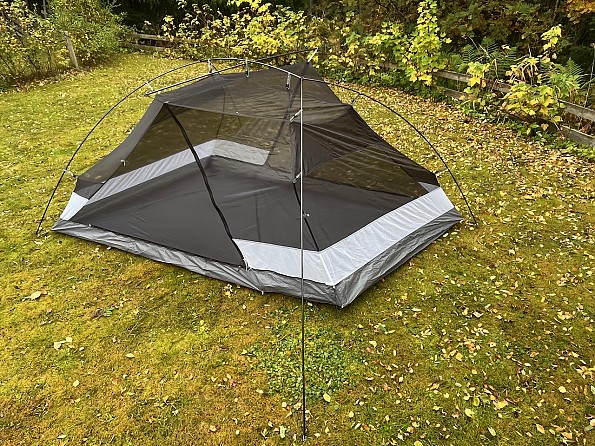
The floating corners are anchored to the corner peg by cords that attach to the floor at the corner and below the end of the main door zipper, with a short vertical bar sewn into the corner to shape the floor. This leaves these corners and the sides of the tent a little loose.
One consequence is that the end of the door zipper isn’t firmly anchored, so that the floor can lift up when pulling on the zipper. But the zippers operate smoothly and I figured out that I can just open the horizontal zipper enough to get a grip on the apex of the door panel and pull diagonally upward, opening both the vertical and horizontal zippers simultaneously. The loose floor can also sag toward the ground when the doors are open. Since this is sheltered by the vestibule it’s not a problem with water getting in, and it actually makes it easy to brush dirt out the door.
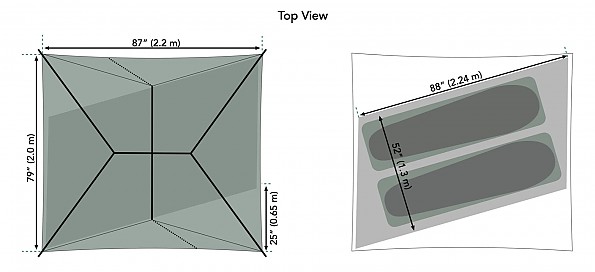
The inner tent floor plan duplicates that of the X-Mids (presumably the X in the tent names): a parallelogram inside the outer rectangle of the fly, so that the overall tent is symmetrical on the diagonal, with diagonally opposite doors and vestibules for both occupants. The long sides of the parallelogram are 88” (224 cm). The inner tent has about about 32 ft2 (3 m2) of floor space.
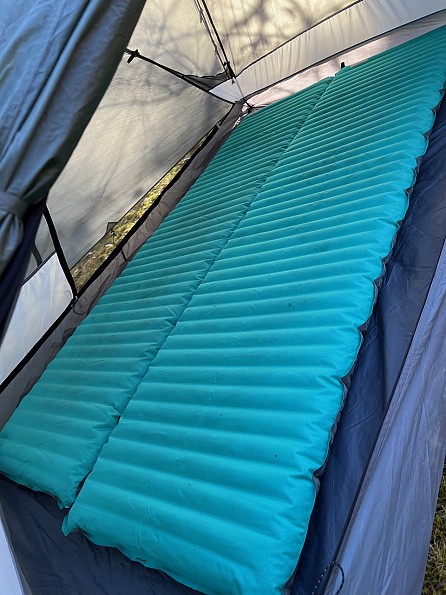
The “sleeper’s rectangle” within the parallelogram works out to about 74x52" (188x130 cm). That gives ample room for our two 20 x 72" (50 x183 cm) sleeping pads with room for a few items stashed alongside and a little triangle for stashing gear at the head of one sleeper and the feet of the other. Two 25" (63 cm) wide pads should still fit, but longer pads might have to be offset a bit lengthwise to avoid conflict with the end walls. Not ideal for couples, but non-intimate tentmates could sleep head-to-foot this way.
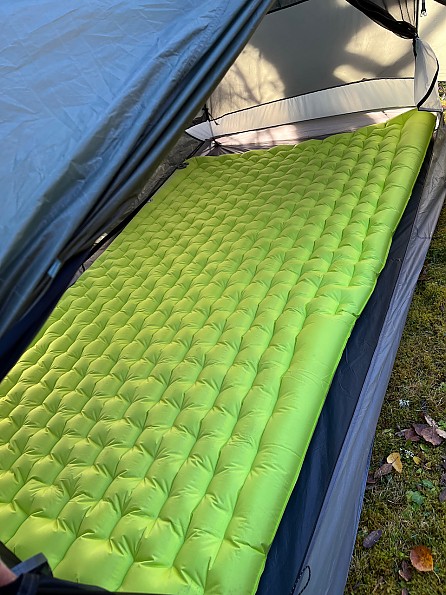
Our extra-kush Big Agnes SLX Tent Floor Pad(78" / 198 cm long and tapering from 50" / 127 cm at the head to 40" / 101 cm at the foot) pushes up against the end walls on two corners but we can probably get away with using it.
I find the parallelogram a little awkward, and, looking at the floor plan, I wonder if it work to have a ca. 85x52" (216 x 130 cm) rectangular inner on one side of the fly, with a big, 25" wide rectangular vestibule on the other side. The occupant opposite the vestibule would have a bit less headroom and no vestibule of her own, but there would be ample room for two full length or even extra-long (i.e. 77"/ 195.6 cm) pads, with more or less room left over at the head or foot. I’d be the first in line to beta test something like that!
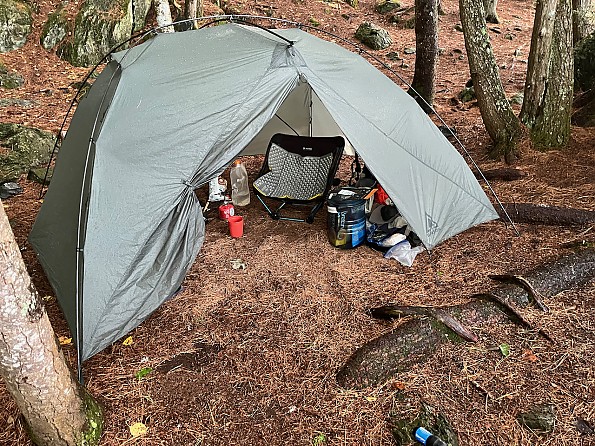
The 43" (1.1 m) center height and near-vertical end and side walls make for lots of headroom when sitting up. Fly-only (rain cave) mode adds 3" / 7.5 cm, giving a little bit more head room away from the center for two people to sit facing each other in chairs for a friendly came of full-contact Scrabble or cribbage while the rain patters down.
Along with relatively easy pitching, that makes the weight penalty of the X-Dome 2 versus X-Mid 2 very much worth it for us. We have, in our years together, spent some long rainy days in various tents, reading and playing Scrabble, mopping up condensation, and dashing out only to pee. This is a tent that can get us through those kinds of days in relative comfort.
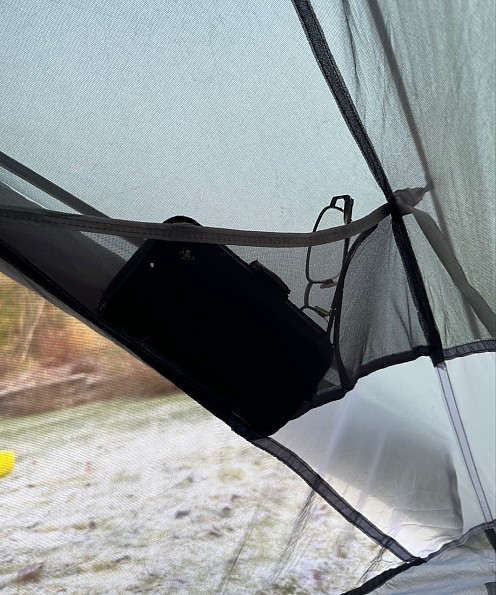
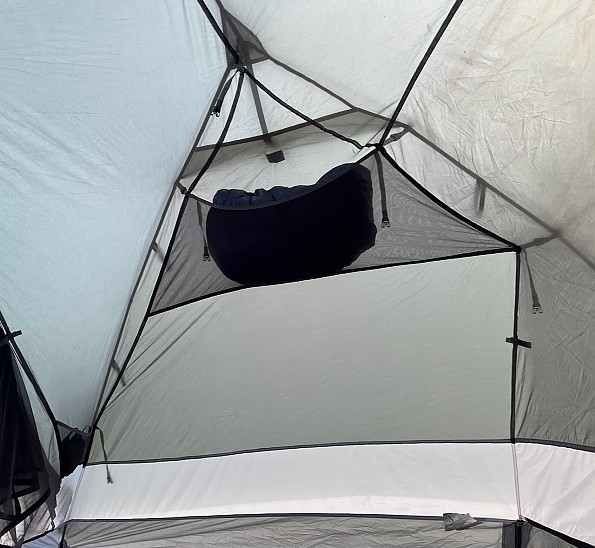
Sadly, only one sleeper (usually Waffle) gets a stash pocket by her head. I like to have one to put my phone, glasses and head lamp in before going to sleep, but have to do without when we share the tent. The tent has two big mosquito netting storage pockets high up at either end. I wouldn’t want to overload them, but they can easily hold a down jacket or other bulky but lightweight items.
Pitching options
This is the best part. With its external pole architecture, the X-Dome 2 can be pitched fly-first, fly only (what I call rain cave mode), inner tent only, or all-in-one, with inner tent already attached to the fly, with or without a footprint already attached to the tent floor. (Scandinavian style tunnel tents offer the same options, but they generally use pole sleeves rather than clips, require more pegs, and have a single front entrance).
This gives a lot of flexibility in dealing with different weather situations. I store the dry tent in the gear cave at home fully assembled and ready to (un)roll, so that the whole thing goes up in the same amount of time that it would take to pitch the fly. The pole ends anchor in the four corners and at the two ends of the crossbar, and a grand total of thirteen clips snug the fly up to the poles.
If I’m expecting rain, I might keep the fly separate so I can put it up in rain cave mode, giving the full height and floor space of the fly for lounging in camp chairs and cooking while the rain patters on the fly. When it’s time to bed down, I install the inner tent with the footprint already attached to the floor. It takes a couple minutes to spread out the inner tent and duck inside, clip the inner tent to the fly at 11 points, then go around the outside inserting the poles into the corner fittings, keeping the inner tent dry the whole time.
On a rainless night, I could put up the inner tent only. Straps on the inner tent wrap around the poles and click into the clips used to connect to the fly; these are left dangling when using the fly. I haven’t done that, partly for privacy reasons when camping near neighbors, but also because of lingering uncertainty about nighttime rain.
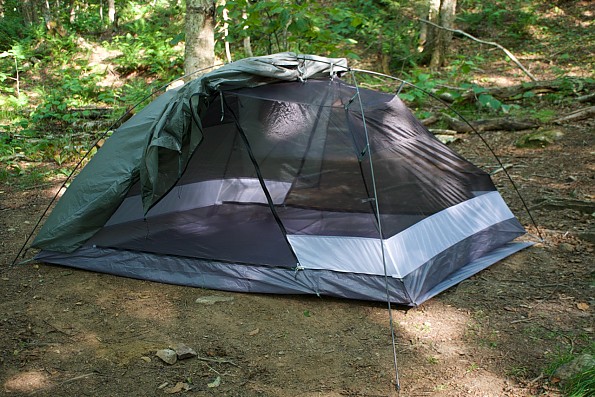
This is one of the drawbacks of the external pole setup. There’s no quick and easy way to close up in the event of an unexpected shower. That applies also to a half-fly mode, with the fly folded back away from the head end of the tent for some low-risk stargazing. In both cases, you’d have to drop some or all of the inner tent, clip the fly on the poles, clip the inner tent to the fly, and anchor the corners of the fly to the pole ends, all by headlamp, while half asleep and probably minimally clothed, and in whatever intensity of rain took you by surprise. With an external fly, you only have to pull or flip the fly over and clip it down, something I have done many times with other tents. For me, the other versatile pitching options outweigh this cost. I’ll save flyless camping for clear, starry nights in the desert.
The reverse options apply when collapsing the tent. If everything is dry I can fold and roll it up in one piece. I there’s condensation on the inside of the fly, I can drop, fold and roll the inner tent under the fly, even if it’s still raining, keeping the walls and canopy dry. If condensation on the footprint has picked up a lot of dirt, leaves or needles, I might detach it and stash it separately to keep everything else clean. One way to do this is to roll the tent up on its side, also a common way to dry the floor on freestanding dome tents.
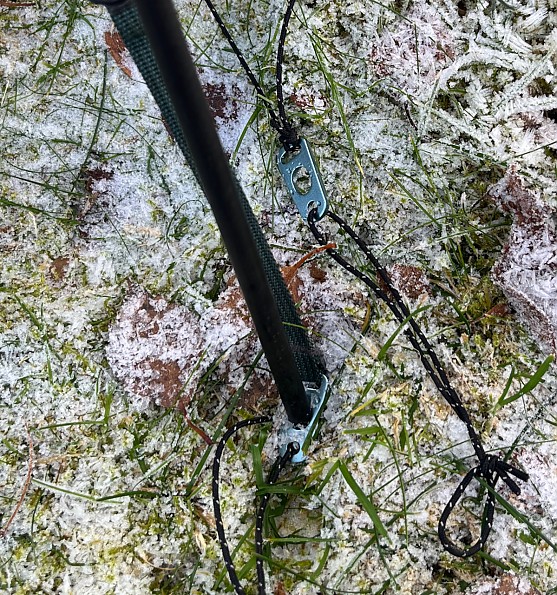
To enable all these pitching variations, the four pole ends are anchored in simple metal fittings on the corners of both the fly and inner tent or just one of the two if they are pitched separately. Here I see room for a small improvement. With the all-in-one or fly-first pitch, the pole ends attach to the fly first, then to the inner. This can involve hunting around under the fly or floor to find the fittings on the corners of the inner, especially the floating corners. This operation would be quicker and easier if the clip pairs were modified to attach together when the tent is stowed all-in-one.
To peg or not to peg (or pole)?
As a simple rectangle, the X-Dome 2 is freestanding, so it can be set up and lived in without any pegs at all, with occupants and gear holding the floor down, without needing to peg out the vestibules as in tents with otherwise similar architecture. But I’ve never met a tent that didn’t appreciate a few good pegs, including this one. It’s a good idea to peg out the four corners, to get everything square and tight and hold the pole ends in place. That’s four pegs.
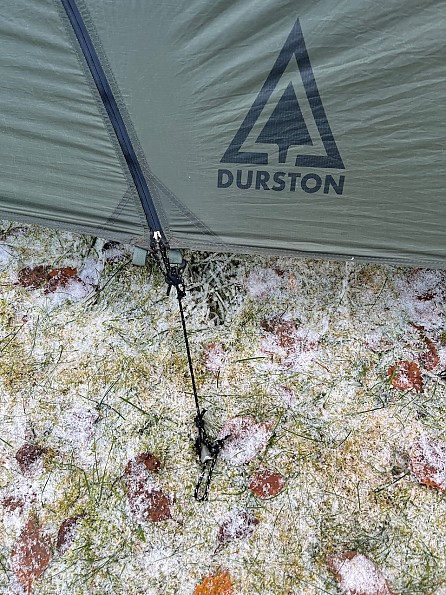
It can also be nice to peg the side walls by the door zippers, maximizing vestibule area and giving something to pull against when opening up for a midnight pee. That’s two more.
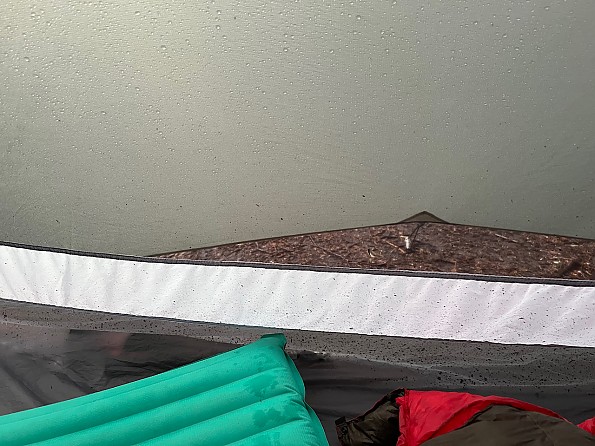
And during heavy rains I’ve experienced some splash-up from the edge of the fly above the bathtub floor at the head and foot ends, so I like to peg out the midpoints, using the loops provided for that purpose. We’re up to eight.
Since all my nights in the X-Dome 2 so far were on forested sites along the AT, I haven’t used the tent in any wind to speak of, but when I use it above treeline here in windy Norway I’ll want to guy out the ends of the tent. Two loops along each of the four legs are provided for that purpose, but they could probably share pegs: four more. The loops can be wrapped around the poles so the guy lines anchor both the fly and the poles.
When things get real rough, Durston suggests pegging out the ends of the crossbar. So we’re up to 14 pegs. In an instructional video, Durston comments that up to 15 pegs could be used to secure the tent in the worst conditions. I’m not sure what the 15th peg would be for, but I’m sure I could find a use for it.
Durston offers another method for stabilizing the tent in wind: the ends of the crossbar can be braced using trekking poles. The handle of the pole inserts into a pocket under the free end of the crossbar and the tip into an adjustable cord loop at the middle of the fly on the bottom. The pole tip can then be jammed into the soil to keep it in place. My lightweight adjustable poles max out at 130 cm and were just barely long enough for the job.
A second cord loop at the bottom of the smaller door flap can be used to brace the crossbar diagonally for a directional wind; I needed 145 cm poles to do this. It seems to me you’d want a third loop in the equivalent position on the long side of the door to get full bracing against a strong wind on one end of the tent. On trying it out, I found that there is some space and movement between the top of the trekking pole and the cross pole, so I’m not really sold on this option.
Some reviewers have noted that the X-Dome 2 presents big, vulnerable surfaces to the wind on all sides so it’s maybe not a tent of choice for windy environments. Point taken. If I’m anticipating a 15-peg wind, I’ll choose another tent, maybe the Hilleberg. Or maybe just stay in a hut.
One side effect of the external pole design is that the corners of the tent will spread apart slightly when the fly is unzipped, making it a bit more difficult to zip closed due to a little extra tension. The corner pegs are attached by cord loops to anchor the corners of the fly but don’t prevent spreading. I’ve seen enough zipper failures in my time to be wary of handling zippers roughly. My approach has been to not peg out the corners too tightly.
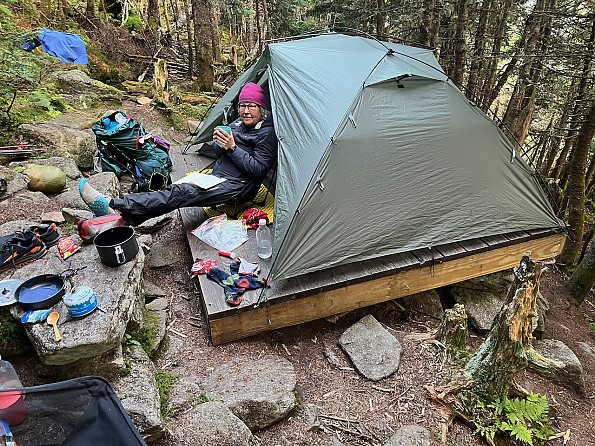
The X-Dome 2 is big enough that it barely fits on some tent platforms, so the spreading can also result in one of the corners falling off the edge of the platform, but this is a minor issue.
Pole issues
An early review of the X-Dome 1+ reported a broken pole in windy conditions. This turned out to be due to a manufacturing defect. The aluminum ferrule linking two pole sections had come unglued and slipped, making it shorter on one side so it put stress on the carbon fiber near the joint. Durston explained this in a response to the reviewer, and of course provided a replacement pole section.
I experienced something similar—the ferrule connecting the spine poles at the top of tent came loose from the pole it was glued into, and was pushed into the pole end by the shock cord so that I couldn’t join the poles together at all. I managed to carefully fish it back out with a twig and eventually superglued it back in place, but the glue set so fast that I didn’t get it properly centered so it was a little short on the glued end and long on the other. I was able to use the poles no problem for the rest of my trip, but in the meantime I contacted Durston and they sent a new pole section, which has a new carbon fiber ferrule firmly glued in place.
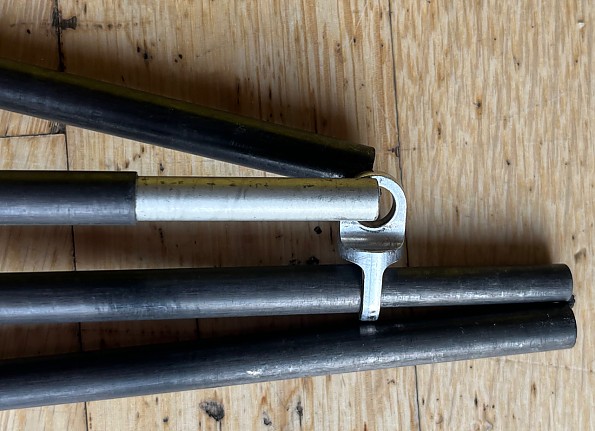
Replacing the pole section was relatively easy, as would replacing all the shock cords when they inevitably wear out. Durston informs me that all new pole sets will have the new carbon fiber ferrules.
Verdict
There’s a lot to like in the X-Dome 2, and the likes far outweigh the few niggles that I have. It is as light or lighter with a bit more space than other tents in the double wall/freestanding class. The double-coated fly and floor hold out water and don't sag when wet, as advertised. Fly-first and rain cave pitching are a big advantage in rain and wind. It has generous vestibules and a lot of interior area and volume, but not all of it is us useable as in tents with a more conventional floor plan. I’d appreciate a higher bathtub floor and/or fly cut closer to the ground to minimize splashback in heavy rain, and solid panels all the way around and perhaps higher up on the walls to stop dust and grit from blowing in (but choosing the solid inner takes care of this).
As noted, I’d like to see the anchors for the pole ends on the fly and inner tent click together somehow to make pitching a bit faster and easier. It's a shame that there is no fast way to pull the fly over when converting from inner-only or half-fly mode, but I don't see a straightforward solution to that one. Finally, I have to wonder if an alternative floor plan might work and be more practical. The current setup with with stash pockets at either end might work well for bros sleeping head-to-foot, but couples wanting to spoon might appreciate a version that can handle a double-wide and extra long mattress.
Durston is known for product improvement as well as customer service, so I hope that some of these small issues will be dealt with in updated versions of the tent. I’m definitely a fan!
Background
We/I have spent about 50 nights in this tent, in forested sites without much wind, including a number of heavy afternoon and evening thundershowers and a couple all-night rains. I have owned and used many different kinds of backpacking and mountaineering tents since my early hiking days in the 1970s, in environments ranging from deserts to high mountains.
Source: bought it new
Price Paid: US $469